••
Insights & Resources
Expert strategies, case studies, and best practices for B2B marketing teams.
Expert strategies, case studies, and best practices for B2B marketing teams.
Ask Claude anything about your LinkedIn Ads, website visitors and CRM deals. DemandSense MCP
Private early access
LinkedIn Ads
Tools & Comparisons
You are running LinkedIn ads at a list of target accounts and Campaign Manager will not tell you which of them saw anything. Impressions, clicks, a cost per lead, and not one company name among them. Both tools exist to close that gap, and both now describe themselves in the same words: ZenABM’s pricing page calls the product “multi-channel revenue attribution and engagement signals for ABM”, which is a fair description of DemandSense too.
So the honest version of DemandSense vs ZenABM is not that one measures and the other acts. Both measure, both tie LinkedIn engagement to deals in your CRM, and both report revenue against it. The split is what the measurement connects to once you have it: in ZenABM the account record is the product; in DemandSense it is what the rest of the platform runs on.
ZenABM reads company-level impressions, clicks and engagement from LinkedIn, Google and Reddit, scores each account, tracks it through ABM stages, and writes the result into your CRM as company properties. It stores deal value and spend per company, so it reports ROAS and pipeline contribution, and Zena answers questions about that in plain language. It does not identify website visitors and it does not schedule or pace ads.
DemandSense puts three signals on one account record: LinkedIn engagement, visits to your site, and movement in your CRM. It names the companies visiting you anywhere in the world and the people behind US visits, scores them against your ICP, and attributes LinkedIn activity to revenue under thresholds you set. The record then does work: closed-won deals go back to LinkedIn through the Conversions API, budget stops reaching accounts that already closed, and four settings Campaign Manager withholds run as controls.
Choose ZenABM if the accounts you care about are already on a list and you need a clear read on how they are engaging. Choose DemandSense if that read has to change something, or if the accounts you most want to catch have not clicked an ad yet.
| What buyers ask for | ZenABM | DemandSense |
|---|---|---|
| Which target accounts saw the ads, including impressions nobody clicked | Yes, from the LinkedIn Ads API | Yes |
| Tie LinkedIn engagement to revenue in the CRM | Yes, deal value and spend stored per company | Yes, under thresholds you set |
| Decide what counts as influence yourself | Account scoring is customisable from Growth up | Awareness, Engagement and Intent, thresholds editable, 3, 6 or 12 month lookback |
| Know who is on the website before they fill in a form | No | Companies globally, people for US traffic, scored against your ICP |
| Send closed deals back to LinkedIn so it optimises toward buyers | No | Yes, Conversions API, with deal value attached |
| Ask the data a question in plain language | Zena, 10 chats a day on Starter, 50 on Growth, unlimited above | AI Co-Pilot in app, plus a read-only MCP server |
| Ask it from Claude or ChatGPT | MCP server, from Growth up | MCP server, early access |
| Salesforce or Attio rather than HubSpot | Salesforce and Attio from Growth up | All three on every plan, webhooks for the rest |
| Change the campaign from inside the tool | No scheduling, pacing or frequency control | Hours, frequency cap by company, ICP-based audience tuning, monthly budget ceiling |
| Stop paying to advertise to accounts that already bought | No | Spend protection, rolling 12-month lookback |
The website row is the one that decides most evaluations. The other to read closely is delivery: ZenABM writes stage changes into your CRM daily, while DemandSense surfaces the same movement in-app, with a webhook push on Plus.
More than a comparison page usually admits. Both read company-level engagement straight from LinkedIn’s advertising API instead of inferring it from reverse-IP, which is what lets either show an account that saw your ads and never clicked. Both count impressions, both write into your CRM without a RevOps project, both charge nothing on your ad spend, and both are running inside an afternoon.
Both report revenue now, too. A comparison claiming that one of these connects LinkedIn to pipeline while the other only reports on ads is out of date, in whichever direction it was pointing.
| Use case | ZenABM | DemandSense |
|---|---|---|
| Show a stakeholder how a target account is progressing | ABM stages you define, and a per-company timeline of the campaigns it touched | Awareness, Engagement and Intent thresholds you set, with Rising Accounts and Opportunity Gap panels, and a report you can set up once and send to people without a login |
| Get a heating account to a BDR without them logging in | Stage change and BDR assignment written into HubSpot or Salesforce on a daily sync | Webhook push on Plus, and scheduled reports to non-users. No CRM stage write-back |
| See which message an account responded to | Campaigns and creatives tagged by intent theme, grouped across accounts | Which campaigns touched the account, paid and organic, and every job title your budget reached. No theme tagging |
| Find a target account reading your pricing page without clicking an ad | Not covered. The signal starts with an ad impression | Companies globally and the people behind US visits, scored against your ICP |
| Stop spend reaching the wrong hours, the same companies, or accounts that already closed | Not covered | Bid-based scheduling, frequency cap by company, suppression and spend protection |
| Feed closed-won revenue back to LinkedIn for optimisation | Not covered | Conversions API, sending deals with their value attached |
| Work in Salesforce or Attio | Salesforce and Attio from Growth up | All three on every plan, webhooks for the rest |
| See what competitors are running on LinkedIn | Not covered | Competitor ad monitoring in the same product |
| Run several client accounts from one login | Agency plan, from three client accounts | Cross-client management included |
| Ask the data a question from Claude or ChatGPT | Read-only MCP server, from Growth up | Read-only MCP in early access, answering from one joined record |
Three rows hide how different the week actually looks.
ZenABM updates an account’s engagement score as it interacts with your ads, moves it through stages you define, and writes the change into your CRM overnight. The per-company timeline shows which campaigns were part of the journey and which job titles engaged.
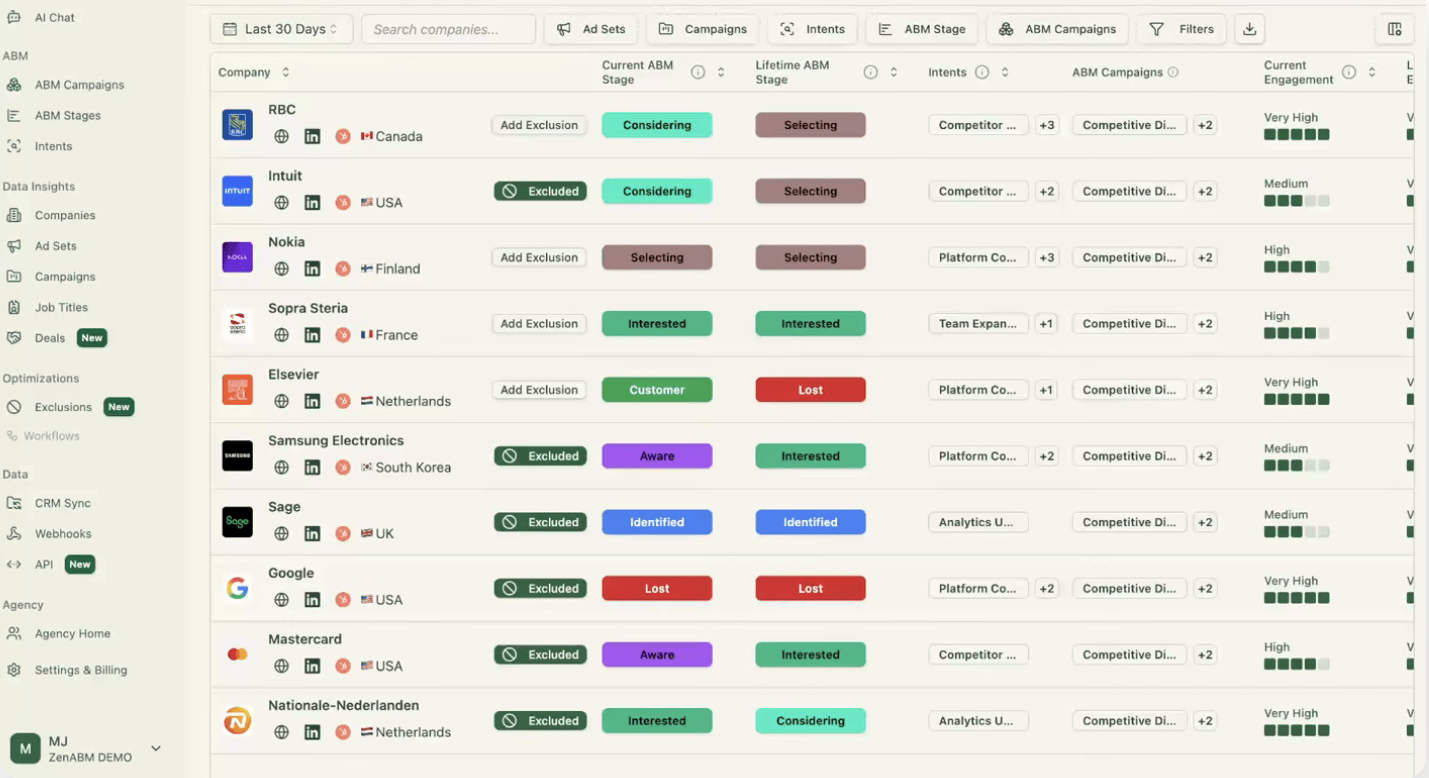
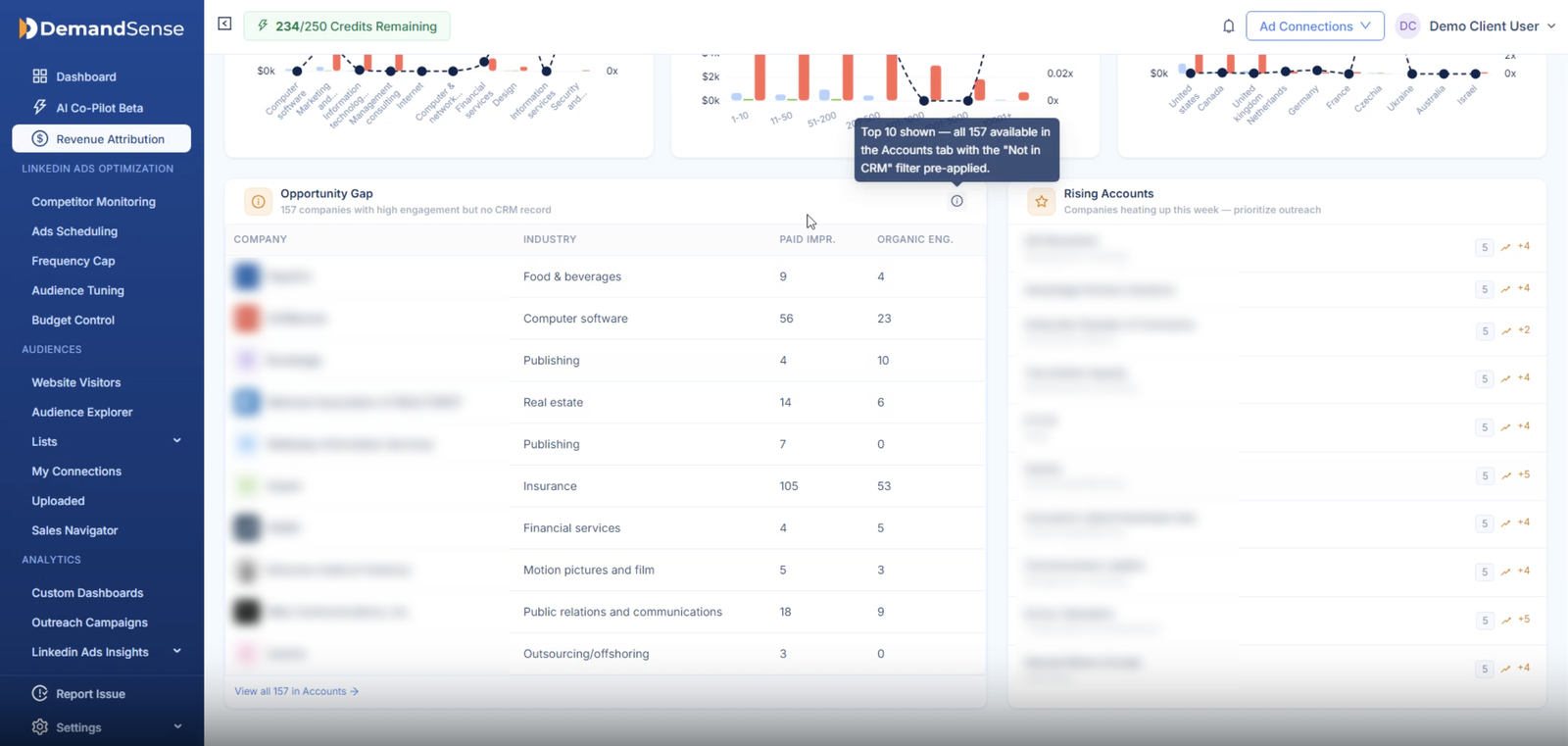
DemandSense reads the same movement, authored differently. Instead of stages set once, an account crosses thresholds you write on Awareness, Engagement and Intent, over a window of three, six or twelve months. Rising Accounts shows what is warming this week and Opportunity Gap the engaged accounts with no deal yet, and the record behind both carries paid and organic LinkedIn, the site visit and the deal, so the progression has the website in it. When the person who needs to see it will not log in, the report is set up once and sent to them.
What happens next is where the two separate. ZenABM does not schedule ads, pace them or cap how often a company sees them, and says so plainly on its own site. In DemandSense those settings sit on the same screen as the account that triggered them: the hours your ads run, a frequency cap per company, exclusions outside your ICP, and a monthly ceiling that restarts on the first. The scheduler drops your bid to a cent outside your hours instead of pausing, so LinkedIn’s optimisation history carries through the night.
Two honest notes. Capping and suppression enforce weekly, so this is faster than a manual edit but not instant, and the controls sit on the $149 plan, not the $89 entry.
A company on your target list read your pricing page twice this week. No form, no ad, so in ZenABM that week did not happen. Its intent signal is built on LinkedIn ad engagement, and that is the boundary of what it can see. DemandSense resolves the visiting company against an identity graph wherever the visit came from, and for US traffic the person behind it, with job title and work email, then scores the account against your ICP. You install it through Google Tag Manager yourself. The visit lands on the same record as the LinkedIn touches and the CRM deal, which is what Opportunity Gap reads from: accounts engaging with you that have no deal yet.
We do not publish an identification rate. Traffic mix decides it, so anyone else’s average is decoration. The trial puts your own number in front of you.
Both get there differently. ZenABM stores deal value and ad spend per company and calculates ROAS and pipeline contribution from the engagement it captured, so impressions count whether or not anyone clicked.
DemandSense hands the definition over. Three presets carry thresholds you can move across paid impressions, organic engagements, clicks and site visits, over a lookback of three, six or twelve months, with Won ROAS on closed revenue. The practical difference is authorship: if your leadership already defines an influenced deal, you enter that instead of adopting theirs.
Everything above is data coming out of LinkedIn. This runs the other way, and it is the largest functional gap between the two tools.
Campaign Manager optimises toward whatever conversion you give it. For most B2B accounts that is a form fill, so LinkedIn learns to find form-fillers, who are not the same population as buyers. Sending the deals instead, server-side from your CRM, lets it learn from who closed. Purchase and Qualified Lead events also carry a 365-day attribution window against 180 for most others, which matters when a deal closes nine months after the impression.
DemandSense feeds it from two directions at once: won deals as Purchase events carrying the amount, and qualified opportunities as Qualified Lead events. Six identifiers travel with each, the sync runs daily, and both land on a conversion rule a campaign can be pointed at. ZenABM does not offer this; its data moves from the ad platforms into your CRM and stops. If the tracking underneath needs setting up first, that is covered in our guide to LinkedIn Ads conversion tracking.
Both answer questions in plain language, in different places. Zena lives in ZenABM, combining ad engagement, spend and CRM deals to explain what drove pipeline and which high-intent accounts sales has not touched; chat volume is capped at ten a day on Starter and fifty on Growth.
Both also expose a read-only MCP server, so the same questions can come from Claude or ChatGPT. What differs is the record underneath: DemandSense MCP joins LinkedIn exposure, the identified site visit and CRM state server-side, so “ICP-fit companies that saw our ads, visited the site and are not in the CRM yet” is answered from one table instead of assembled from three. Our walkthrough of analysing LinkedIn Ads with Claude shows it on a live account.
On both sides. The most common note among ZenABM’s reviewers is that the AI layer is still finding its feet, and their scoring is fixed to defaults below the Growth tier. DemandSense users may need some time getting used to everything the platform does. Both products change month to month, so treat these as things to check in your own trial, not settled verdicts.
Both rate 5.0 on G2, which sounds identical until you read the counts: fourteen reviews against six. Neither base is large enough to lean on.
| DemandSense | ZenABM | |
|---|---|---|
| Entry | $89/mo: 200 credits, visitor identification, ad analytics, competitor monitoring | $69/mo, or $59 on an annual commitment: one ABM campaign, HubSpot, default scoring |
| Attribution | From $149/mo: 500 credits, revenue attribution, the four controls, lead scoring | $199/mo, or $159 annual: three campaigns, customisable scoring, Salesforce, Attio, API, MCP |
| Upper | Credit ladder to $999/mo at 10,000 credits | $499/mo, or $399 annual: unlimited campaigns, unlimited Zena |
| Agency | Cross-client management included | $599/mo, or $479 annual: from three client accounts |
| CRMs | HubSpot, Salesforce, Attio,on every plan | HubSpot on every plan; Salesforce and Attio from Growth |
| Commitment | Monthly | Monthly, or annual at roughly two months free |
| Free trial | 30 days, every feature, no credit card | 37 days, backfills 90 days of ad history |
| G2 | 5.0 from 14 reviews | 5.0 from 6 reviews |
Read that by tier and by commitment, because the ZenABM figures quoted everywhere are the annual ones. Their month-to-month entry is $69 against our $89, covering HubSpot and default scoring. The lines cross at the tier most teams need: if you run Salesforce, Attio, or want scoring you can edit, that is $199 against DemandSense’s $149.
Prices are as published on both sites in September 2026.
Choose ZenABM if the list of accounts is settled, nobody is going to change the campaigns, and what you need is stage-by-stage progress written into the CRM for sales to work from. That is the job they have built for, and the 37-day trial opens with 90 days of your history.
Choose DemandSense if the read has to do something. The same attribution is there from $149, under thresholds you set instead of inherit, wired to things a scoring layer cannot reach: the account on your pricing page that has never clicked an ad, the budget still running at two in the morning, the forty companies absorbing your impressions, and LinkedIn optimising on closed deals instead of form fills.
Both trials run without a credit card, which makes this a cheap decision to test properly. Open a trial against the account you are running now, and compare the two reads on the same fortnight.
Yes, from the $149 plan. It connects LinkedIn engagement, website visits and CRM activity on one account record and reports influenced pipeline, revenue and Won ROAS under Awareness, Engagement and Intent models, with editable thresholds and a three, six or twelve month lookback. Comparisons claiming it stops at ad delivery describe an older product.
No. Its intent signal comes from company-level LinkedIn ad engagement pulled from the advertising API, so a target account reading your site without ever seeing an ad does not appear. DemandSense names visiting companies globally and individual visitors from US traffic, with job title and work email.
As of September 2026, no. Its integrations move data from the ad platforms into your CRM and alerting tools. DemandSense sends closed-won deals back as Purchase events with the deal amount attached, and qualified opportunities as Qualified Lead events, server-side on a daily sync.
From the Growth plan up, $199 a month or $159 on an annual commitment. HubSpot is on every tier, and Attio starts at Growth alongside Salesforce. All three sit on every DemandSense plan, with webhooks covering anything outside them.
Get expert insights and strategies delivered to your inbox weekly.
Book a personalized demo and discover how we can transform your B2B marketing.
See a quick demo video
Revenue Attribution & Measurement
Tools & Comparisons
DemandSense vs Fibbler compared by the job you are hiring for: use cases, Conversions API, MCP, ad controls, pricing, and what reviewers of both tools say.

Tools & Comparisons
Choose the right B2B customer data platform for better audience & account intelligence. Learn how a CDP empowers your B2B customer data strategy.

Revenue Attribution & Measurement
Tools & Comparisons
Discover the best marketing intelligence platforms for B2B. Empower marketing and revenue teams with competitive and market intelligence tools.