••
Insights & Resources
Expert strategies, case studies, and best practices for B2B marketing teams.
Expert strategies, case studies, and best practices for B2B marketing teams.
Ask Claude anything about your LinkedIn Ads, website visitors and CRM deals. DemandSense MCP
Private early access
Revenue Attribution & Measurement
You check your LinkedIn ad performance and see impressions and click-through rates. Sometimes the numbers look good; sometimes they are disappointing.
And when leadership asks how the campaigns influence pipeline, you open the CRM. You compare the numbers between LinkedIn Campaign Manager and your CRM, and they don’t match.
You are fairly sure your campaigns are working, but since you can’t prove the return on ad spend, budgets get cut.
LinkedIn’s native attribution alone can’t solve this. It runs on a last-touch attribution model and only counts the conversion events you send it, inside a window you set per conversion rule. Meanwhile the typical B2B buying journey takes around 272 days and 88 touchpoints, according to Dreamdata’s 2026 LinkedIn Ads Benchmarks Report. Most of the deals your LinkedIn campaigns influenced never show up in the conversion data at all.
To see how LinkedIn campaigns influence pipeline and revenue, you need multi-touch revenue attribution. Here’s how to build it.
LinkedIn pipeline attribution is the process of connecting open and closed-won deals back to the LinkedIn campaigns that influenced them — whether or not anyone clicked an ad or filled out a form.
Most of the time, B2B teams assume their LinkedIn ads aren’t working because they don’t bring in leads immediately. But LinkedIn is a demand generation platform more than a lead generation platform.
B2B buyers don’t impulse-buy. They research, and they compare notes with the rest of the buying committee before settling on a vendor. The 95-5 rule, popularised by the Ehrenberg-Bass Institute and the LinkedIn B2B Institute, holds that only about 5% of your market is in-market to buy at any given moment; the other 95% are not shopping yet. The job of a LinkedIn campaign is to build recognition and trust with that 95%, so that when they do enter the market, you’re on the list.
LinkedIn usually does that job and rarely gets credit for it. Campaign Manager reports clicks, impressions and the conversion events you’ve instrumented — it has no way to connect an impression to a deal record in your CRM months later.
With multi-touch attribution, you connect LinkedIn data to CRM data and see every step from first touch to closed-won. So if a company sees your ad today and doesn’t convert until December, LinkedIn still gets credit for the awareness and nurture that got them there.
Native attribution runs into three structural problems.
Campaign Manager defaults to a 30-day click and 7-day view window, and most accounts never change it. You can extend it — 90 days for standard conversions, or 365 days for lead and purchase events sent through the Conversions API — but that’s a setting you have to configure per conversion rule, and even at maximum, LinkedIn only counts the conversion event you send it. When a deal takes six months or more to close, the revenue lands outside the window entirely. Without a CRM sync feeding outcomes back, LinkedIn never learns which campaigns produced it.
Native attribution credits the campaign that produced the direct conversion — the lead gen form fill — and ignores every campaign that warmed that same buyer up beforehand. The result is a reporting picture where sales gets the credit for deals that marketing spent months seeding. That gap is influenced revenue, and last-click reporting hides all of it.
B2B teams buy in groups. Gartner’s research puts the typical buying group at six to ten stakeholders, each of whom interacts with your ads differently. When Campaign Manager reports total individual clicks, you can’t tell whether those clicks came from decision-makers at a target account or from a scattering of unrelated people. For account-based campaigns you need both account-level and contact-level views to make sense of the data — which is why account-based marketing attribution works differently from standard campaign reporting.
Native attribution is fine for managing campaign health while campaigns run. It can’t prove return on ad spend, revenue influence, or pipeline influence unless you connect LinkedIn to your CRM.
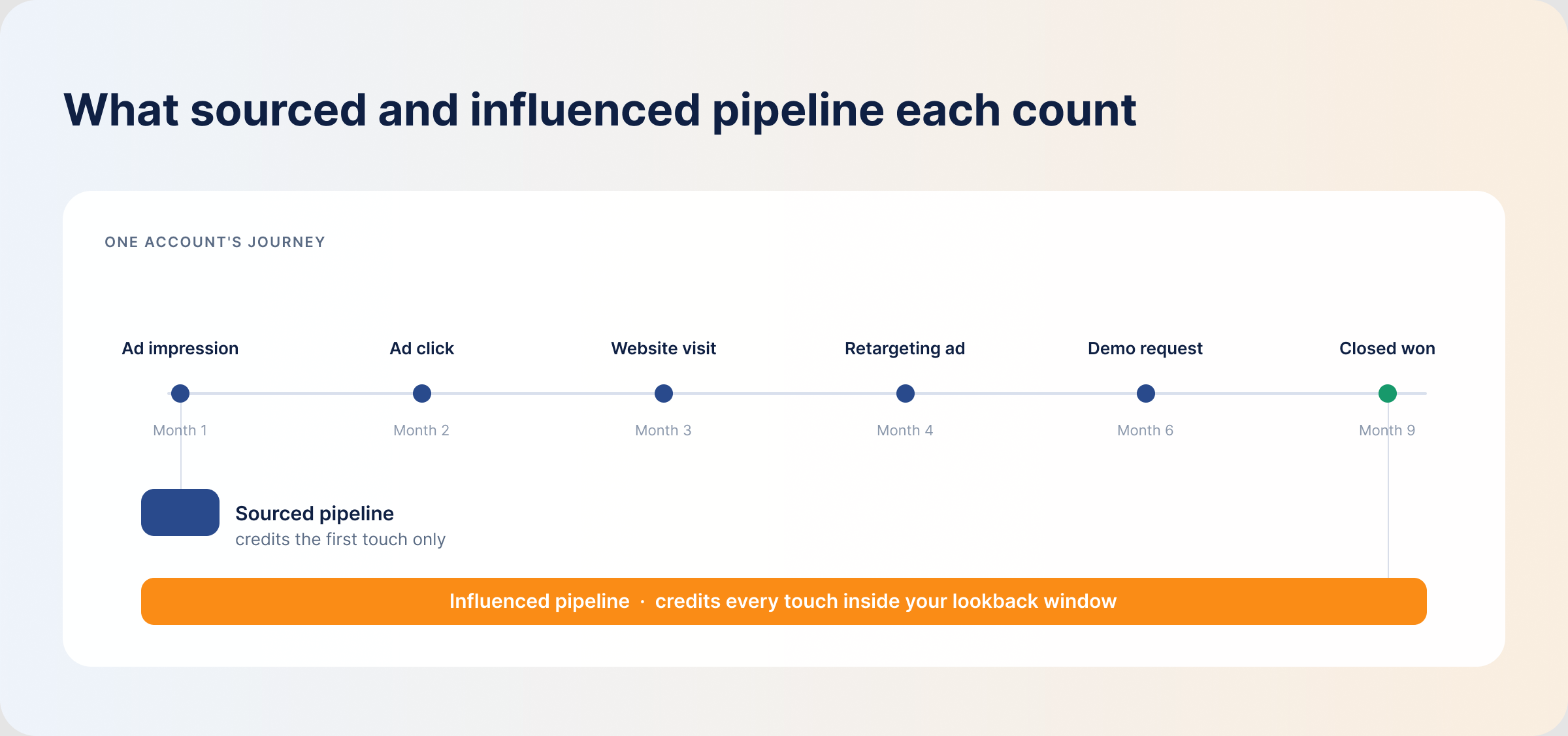
Every touchpoint in the buyer’s journey matters, and you need to give credit where it’s due. That means capturing two different measures, not one.
Sourced pipeline explains the origin of a deal: what introduced this account to your brand the first time? A cold email, or a LinkedIn ad? First-touch attribution tells you where deals start — demand creation.
Influenced pipeline captures every campaign that moved the buyer forward after that first touch — demand acceleration.
When a deal starts from a marketing-owned channel (paid ads, organic posts, outbound marketing email), it’s marketing-sourced pipeline. When a buyer interacts with marketing content at any point in their journey — even if marketing didn’t own the first touch — that deal is marketing-influenced pipeline.
The two overlap almost all the time, because your campaigns are frequently responsible for both the start and the progression of a deal. Measure both anyway. They answer different questions.
Use marketing-sourced pipeline for budget allocation. Fund the campaigns that reliably bring new accounts into the funnel — without them, there’s no deal to influence.
Use marketing-influenced pipeline to judge mid-funnel content and messaging. Are your campaigns pushing buyers forward, or are they where buyers quietly drop out?
The relationship between the two numbers is a useful diagnostic. Influenced pipeline should comfortably exceed sourced pipeline — if the two are close, your influence definition is too strict and marketing isn’t getting credit for work it’s doing. If influenced pipeline dwarfs sourced pipeline by a wide margin, the opposite is true: you’re probably counting trivial activity, like a single page visit or one impression, as influence.
There is no universal correct ratio. What matters is that the gap is stable and that you can explain what’s inside it. If the number moves sharply and your campaigns haven’t changed, your definition has drifted — not your performance.
This is the step everything else depends on. Authorise your CRM alongside your LinkedIn ad account so that ad activity and deal records live in the same system and are matched at the company level. Once connected, deal stages, amounts and close dates flow back automatically, so a deal that closes in month seven can still be traced to the impression that started it in month one.
The result: you can match LinkedIn ad performance to open deals in pipeline and finally see which campaigns influenced them, even when buyers never clicked or filled out a form. If you’re evaluating how to set this up in practice, our guide to multi-touch attribution in Salesforce and HubSpot walks through the mechanics.
Look at buying committee coverage per account. B2B deals involve multiple stakeholders, and clicks alone will mislead you.
Say one campaign gets 20 clicks. You check members engaged per account and find one or two — the rest come from people you have no commercial interest in. Without CRM context, most teams would call that a high performer.
Another campaign drives seven clicks, but five of them come from stakeholders inside a single target account. That’s the better account-based campaign, because it reached most of a buying committee. The full set of LinkedIn ads metrics worth tracking gets more useful once you can read them at account level.
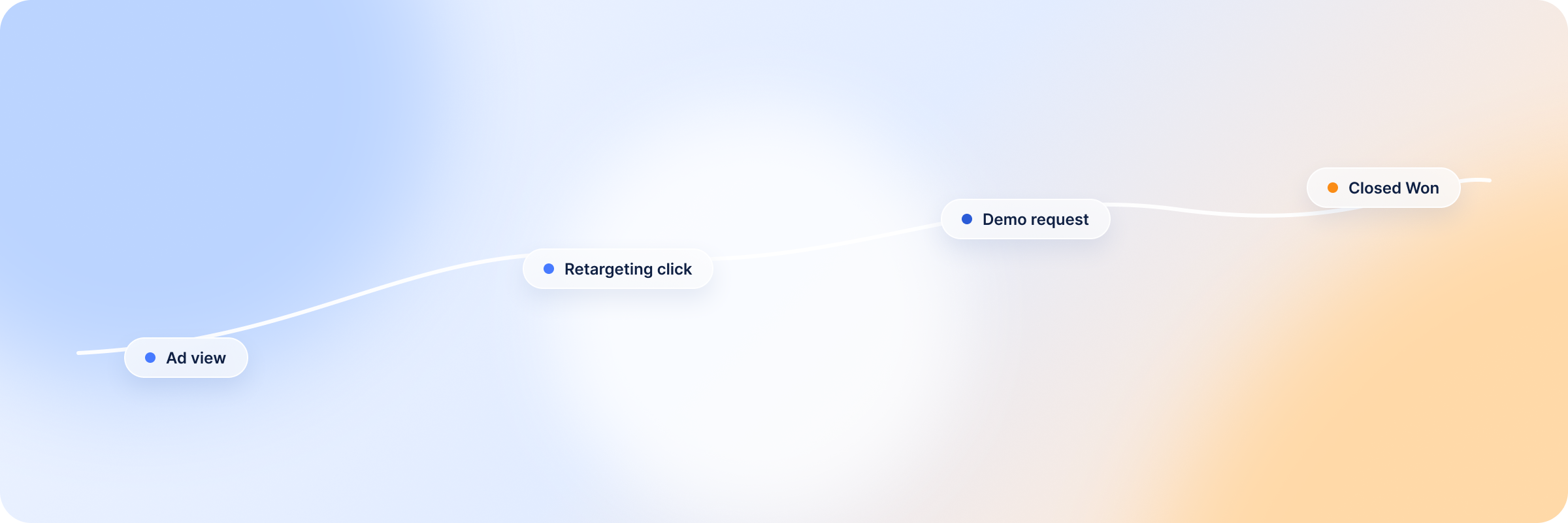
LinkedIn campaigns influence deals indirectly all the time. Visualise the customer journey from first touchpoint to last, so you can see how LinkedIn activity moves accounts from opportunity to closed-won or closed-lost — and where in that sequence deals stall.
You don’t want sales and marketing arguing over inflated numbers. Define explicitly what qualifies as sourced revenue and what qualifies as influenced revenue, write it down, and get both teams to agree before the first report goes out.
Not every open opportunity becomes revenue. Checking pipeline regularly shows you how accounts progress through the funnel — which tells you who belongs in retargeting campaigns and who should be excluded, closed-won accounts most obviously among them.
The metrics that matter most:
Read these alongside clicks and impressions rather than instead of them. Delivery metrics tell you whether campaigns are healthy; pipeline metrics tell you whether they’re working.
Attribution isn’t only for reporting. It’s for LinkedIn ads optimization too. Once LinkedIn data and CRM data sit together, you stop optimizing for clicks and start optimizing for business outcomes.
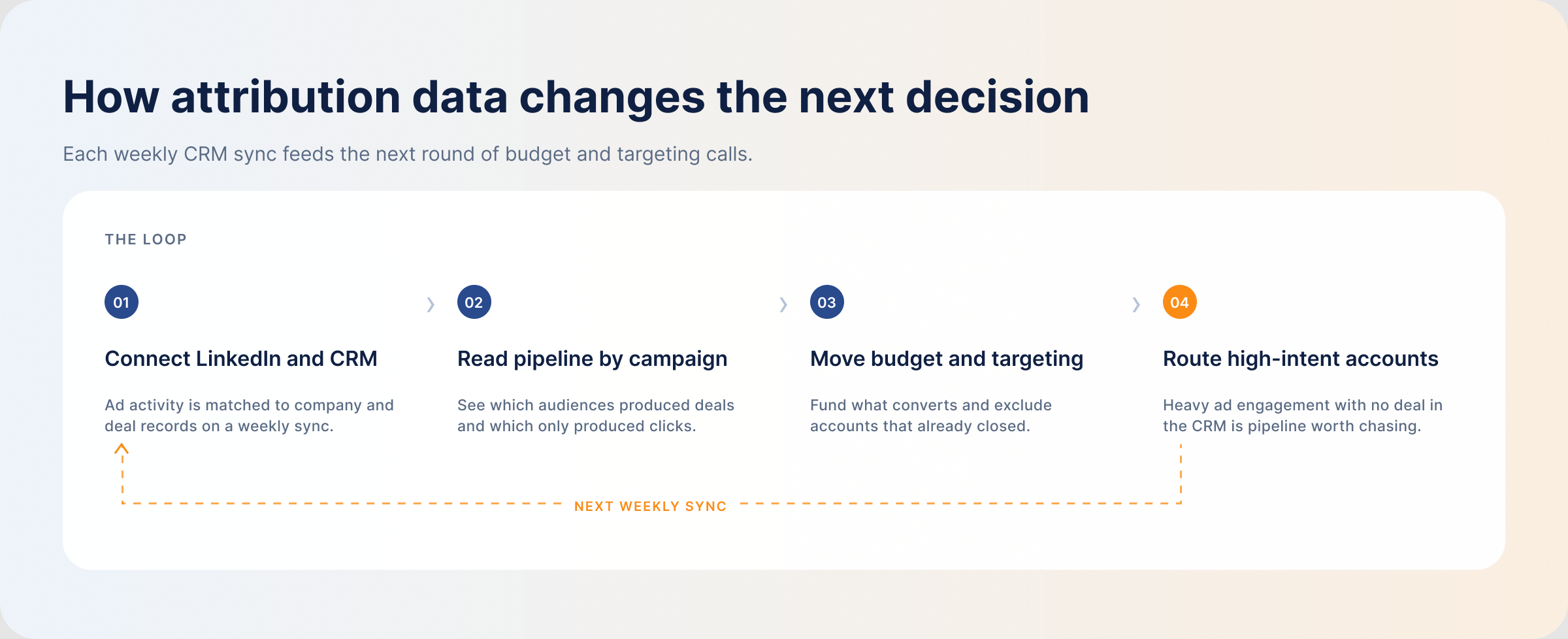
Don’t save attribution for the end-of-month ROAS report. Use it to steer campaigns while they’re running.
Campaign Manager is enough for some programs. It stops being enough when:
If two or more of these describe your program, native reporting will keep understating LinkedIn. Our breakdown of how to track LinkedIn ad influence on pipeline beyond last-click goes deeper on the tracking mechanics, and our comparison of attribution software for B2B LinkedIn advertisers covers how the main options differ.
DemandSense Revenue Attribution connects your LinkedIn ads data to your CRM — HubSpot, Salesforce or Attio, with webhooks for anything else — and shows how campaigns influence opportunities, pipeline and revenue.
It matches the companies seeing your ads to open deals in pipeline and syncs that data weekly. From there you get influenced pipeline, influenced closed-won revenue and won ROAS, broken down by campaign, audience, account and segment.
The part most tools don’t give you: you decide what “influenced” means. Impressions, clicks, engagements or website visits — pick one of three presets or set your own thresholds, then choose the lookback window that matches your actual sales cycle. The default is six months, which suits most B2B programs, but it’s yours to change. Most attribution tools make that decision for you and don’t tell you what they chose.
Paid and organic LinkedIn activity appear on the same account timeline, alongside the website visits that followed and the CRM deal events — so you can see the full sequence that led to a deal rather than a single attributed touch. And because the system knows which accounts already closed, Spend Protection stops you paying to advertise to customers you’ve already won.
Many B2B teams struggle to prove LinkedIn’s contribution to revenue. With attribution logic you set yourself and a lookback window that matches how your buyers actually behave, that stops being a guess.
Yes — especially with cold audiences. A buyer can see your ad, ignore it, and still carry the impression into the research they do weeks later. The ad shaped the decision without ever registering a click. This is exactly why influenced pipeline and influenced revenue are worth measuring separately from conversions.
Use an attribution platform that supports your CRM. DemandSense integrates with HubSpot, Salesforce and Attio, with webhooks available for other systems, and syncs LinkedIn ad activity against your deal records automatically.
It depends entirely on how long your buyers take to decide. LinkedIn’s 30-day default misses most of a typical B2B journey. Look at your own average sales cycle in the CRM, then choose a window that comfortably covers it. DemandSense uses a configurable lookback window with a six-month default.
Measure at the account level. B2B deals involve buying committees, so several stakeholders from one target account engaging with your ads is a stronger buying signal than the same number of clicks spread across unrelated individuals. Our guide to measuring account-based marketing covers the metrics that make this readable.
Set explicit rules for what qualifies as influence and get sales and marketing to agree on them before you report. Then connect CRM and LinkedIn data so both teams are reading the same numbers from the same place, rather than reconciling two conflicting reports.
It depends on the campaign objective, but optimizing for pipeline and revenue generally produces better outcomes. Optimizing for lead volume tends to attract the wrong crowd, and some of the strongest B2B campaigns produce very few — but very good — leads. Allocate budget on lead count alone and you’ll cut the wrong campaign.
Get expert insights and strategies delivered to your inbox weekly.
Book a personalized demo and discover how we can transform your B2B marketing.
See a quick demo video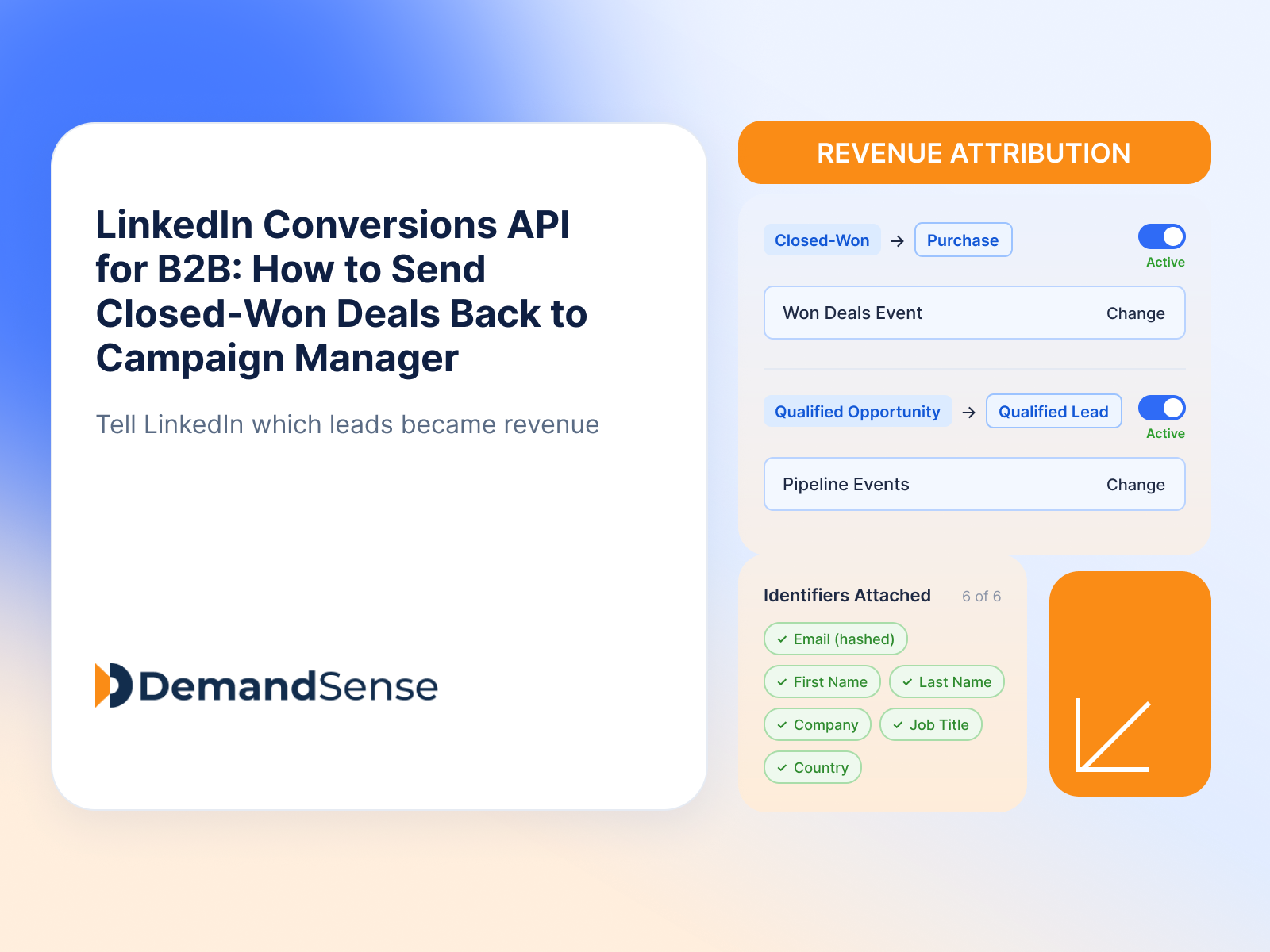
LinkedIn Ads
Revenue Attribution & Measurement
How the LinkedIn Conversions API works, what to send, how it fits with the Insight Tag, and how B2B teams get closed-won deals into Campaign Manager.

Revenue Attribution & Measurement
Tools & Comparisons
DemandSense vs Fibbler compared by the job you are hiring for: use cases, Conversions API, MCP, ad controls, pricing, and what reviewers of both tools say.

Revenue Attribution & Measurement
Tools & Comparisons
Discover the best marketing intelligence platforms for B2B. Empower marketing and revenue teams with competitive and market intelligence tools.