••
Insights & Resources
Expert strategies, case studies, and best practices for B2B marketing teams.
Expert strategies, case studies, and best practices for B2B marketing teams.

You picked the accounts, built the audiences and ran the campaigns, and now two questions keep coming back. Which people inside those accounts did we actually reach, and did any of it turn into pipeline? Vector relaunched on 16 September 2026 around exactly those questions, under a new line: “ABM finally works the way you thought it would.”
The new Vector is a full ABM platform. It collects more than 30 kinds of buying signal, places each tracked account in a buying stage with the evidence for it, pushes contact-level audiences to ten ad networks and writes a story for every deal that opens or closes. The comparison pages on its own site set it against 6sense and Demandbase, and every plan starts from a $3,000 monthly platform fee.
DemandSense starts from the LinkedIn campaign and works outward. It reads engagement on LinkedIn, visits to your site and movement in your CRM, measures what influenced pipeline under thresholds you set, and then changes what the campaign does next, from $89 a month.
Vector is an ABM platform built on contact-level signals. It tracks the accounts you choose, places them in five buying stages (Identified, Aware, Interested, Considering, Selecting) using signals such as research intent, site activity, LinkedIn engagement, CRM activity, job changes and AI web research, and lists the evidence behind each stage. It builds contact-level audiences for LinkedIn, Google, Meta, YouTube, Reddit, TikTok, Snapchat, Pinterest, X and Bing, tunes LinkedIn bids with its Bid Agent, and turns each opened or closed-won deal into an Account Story. Pricing is a $3,000 monthly platform fee plus credits for tracked accounts, site traffic, premium signals and bid agents.
DemandSense identifies the companies visiting your site from anywhere in the world and the people behind US visits, scores them against your ICP, and measures LinkedIn’s influence on pipeline under Awareness, Engagement and Intent thresholds you set. It then acts on that read: closed-won deals go back to LinkedIn through the Conversions API, spend protection keeps budget off accounts that already bought, and four settings Campaign Manager does not offer control when your ads run, how often one company sees them, who they reach and when spending stops. Every feature is on every plan from $89 a month.
Choose Vector if you are replacing a legacy ABM platform and running one programme across many ad networks. Choose DemandSense if your account-based budget runs through LinkedIn and has to prove itself while the campaigns are still live.
Read the table by where your budget goes. If one programme has to run across ten ad networks, the audience row is the one Vector built its relaunch around. If the budget runs through LinkedIn, the rows that decide it are delivery, closed-won revenue and accounts that already bought.
Both now answer the same first questions. Both identify visitors to your site at company and person level. Both show why an account sits where it does: Vector cites the signals behind each stage, and DemandSense lets you write the thresholds. Both lay out an account’s activity as a journey, connect ad engagement to deals in HubSpot or Salesforce, and offer a read-only MCP server for Claude and ChatGPT. Both price on credits above a base plan. If what you need is a view of which accounts are warming up that you can defend in a meeting, either will give you one.
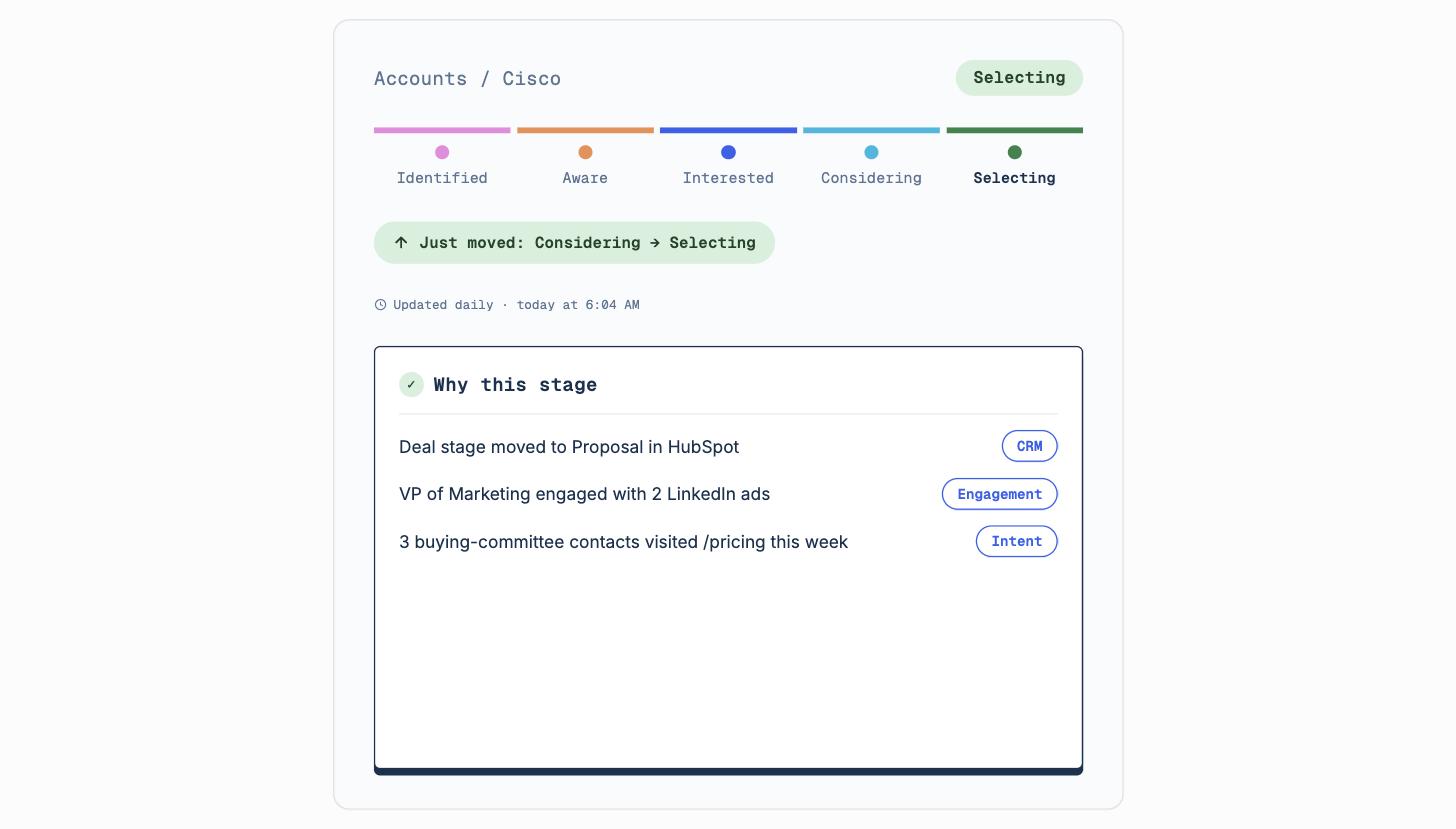
Vector’s relaunch puts its weight here. A signal library of more than 30 types covers research intent across 36,000+ topics, site activity, LinkedIn organic reach and post engagement, CRM and HubSpot marketing activity, Fathom call recordings, job changes and AI research into funding and press. You switch on the signals that fit how you sell, premium ones draw credits while your own CRM and form data does not, and each account you track lands in a stage from Identified to Selecting with the reasons listed underneath. Stages refresh daily, and the contact-by-contact journey behind them refreshes weekly unless you pay for daily.
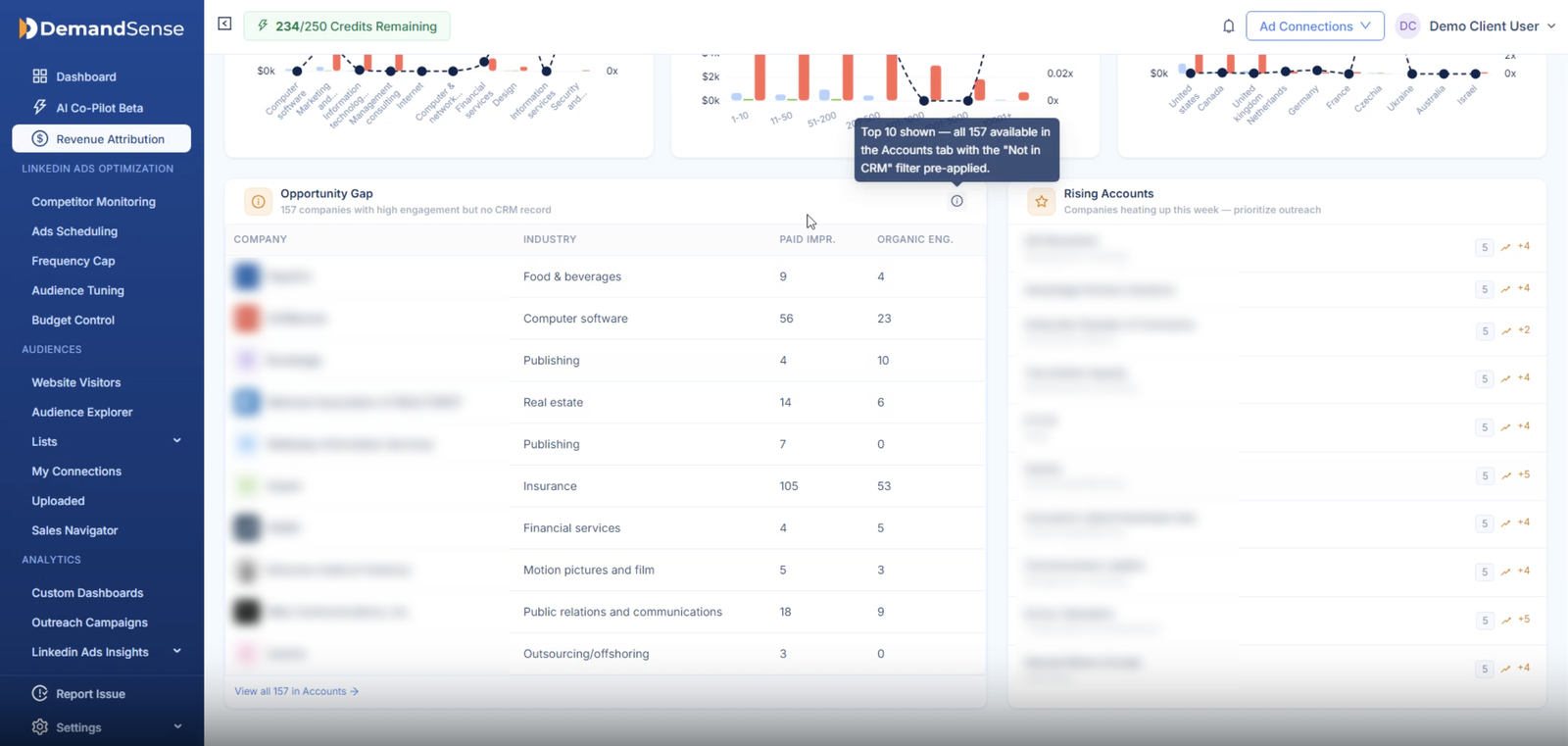
DemandSense builds the same picture from the activity your own programme creates. Awareness, Engagement and Intent each carry thresholds you set across paid impressions, organic engagements, clicks and site visits, over three, six or twelve months, so an account’s position traces back to rules you can read out in a meeting. Rising Accounts shows who is warming up this week, and Opportunity Gap lists the engaged accounts with no deal in the CRM yet. Identification reaches companies anywhere in the world and the people behind US visits, while Vector’s own help centre describes its identification as geofenced to the US.
Vector pushes contact-level audiences to ten networks: LinkedIn, Google, Meta, YouTube, Reddit, TikTok, Snapchat, Pinterest, X and Bing. At launch its FAQ lists tracked account and account stage as the new audience conditions alongside its existing segments, with individual signals as conditions planned for later. On LinkedIn, Bid Agent adjusts bids every 15 minutes and paces budget across the week instead of by the day, and each bid agent draws credits.
DemandSense pushes ICP-scored segments to LinkedIn as custom audiences. What it adds is control over the campaign once the audience is live. Outside the hours you choose, the bid drops to a cent instead of the campaign pausing, so LinkedIn keeps its learning overnight. A frequency cap stops one company absorbing your impressions, audience tuning shows every job title and company the budget reached and suppresses a competitor, a customer or an active deal in one click, and a monthly ceiling pauses campaigns at your cap and restarts them on the first.
When an opportunity opens or a deal closes won, Vector’s Account Stories look back across the account’s signals and write the journey as a narrative: the moments that moved it, the people involved, the order it happened in and the creative they saw. Stories export as a link or an image for a review deck. Its FAQ says this is deliberately not multi-touch attribution: each story lists the touches in the order they happened, and no model divides the deal between them.
DemandSense measures influence across the whole programme. The thresholds you set decide what counts as influenced, and the reporting adds it up: influenced pipeline, revenue and Won ROAS, split by industry, headcount and country, with each account’s journey alongside. A story is written once a deal exists. The thresholds are running before that, so the accounts crossing Intent this month are visible while the campaigns that moved them are still live, and the same definitions produce the pipeline number when the budget is reviewed.
A Vector Account Story ends with the deal marked closed in your CRM. Nothing on Vector’s site describes sending that deal back to LinkedIn, so Campaign Manager keeps optimising against whatever conversion you set up months ago.
For most B2B accounts that conversion is a form fill. Sharper audiences and faster bids still feed a platform that learns from it, so LinkedIn keeps finding more of the people who fill in forms, a group that overlaps your buyers without being them.
DemandSense returns the outcome. Won deals go to LinkedIn as Purchase events with the deal amount attached and qualified opportunities as Qualified Lead events, six identifiers apiece on a daily sync, each mapped to a conversion rule a campaign can optimise toward. Those two event types hold a 365-day window where most others stop at 180, which is what lets a nine-month deal count. The setup around it is in the DemandSense guide to LinkedIn Ads conversion tracking.
Both tools now ship a read-only MCP server for Claude and ChatGPT, so the comparison comes down to what each one can see. Vector MCP covers LinkedIn Ads performance, down to campaigns, creatives, bids and spend, plus identified site visitors, and its FAQ lists more platforms as roadmap. It is included in the platform fee.
DemandSense MCP, open on every plan and included in the trial, covers LinkedIn ad exposure and identified visits and adds the CRM state. A question like “ICP-fit companies that saw our ads, visited the site and are not in the CRM yet” depends on that third source, since its last clause can only be answered from the CRM. A walkthrough with Claude runs it on a live account.
On Vector’s side, much of what a buyer will want to check is new. The relaunch went live on 16 September 2026, so its reviews describe the product it replaced, and some pieces arrive in stages: individual signals as audience conditions are planned for later, and the contact-level journey refreshes weekly unless you pay for daily. The bill starts with a platform fee before usage, and the exact figure comes after a demo.
On DemandSense, it takes some time to get used to everything the platform does, and frequency capping and suppression enforce weekly rather than on the click. Both products change month to month, so test these in a trial of your own.
Both rate well on G2, 4.9 for Vector and 5.0 for DemandSense, and both sets of reviews were written before Vector’s relaunch.
| DemandSense | Vector | |
|---|---|---|
| Starting price | $89/mo: 200 credits, every feature | $3,000/mo platform fee, including 50,000 credits |
| What the base covers | Every feature | Account journeys, account selection, core reporting, CRM and ad integrations, MCP and basic signals |
| What adds cost | More credits: Plus from $149/mo at 500, up to $999/mo at 10,000 | Credits for tracked accounts, site traffic, premium signals and bid agents beyond the included 50,000 |
| Published examples | $89, then $149 to $999 a month | $3,000, $6,300 and $9,600 a month in its calculator |
| Billing | Monthly | Monthly at smaller volumes, annual and sales-assisted at higher ones |
| How you start | 30-day free trial, no card | Calculator estimate, then a demo for a quote |
| G2 | 5.0 | 4.9 |
The difference starts at the base: $89 against a $3,000 platform fee, before either bill grows. Both then charge in credits, so size each one against your own account list and traffic. Vector describes its calculator as an estimate built from the same model its sales team quotes from.
Vector helps you choose where to look. DemandSense measures what the LinkedIn spend produced, changes the campaign because of it, and hands the result back to LinkedIn, so each month’s targeting starts from what closed.
Choose Vector if you are replacing a legacy ABM platform, the programme runs across several ad networks at once, and you want third-party signals deciding where the team looks next. That is the job its relaunch was built around, and its pricing is set for it.
Choose DemandSense if LinkedIn is where the account-based budget goes and that budget has to justify itself while it is still being spent. It measures influence against thresholds you set, changes what the campaigns do, and tells LinkedIn which deals closed, from $89 a month.
Start a 30-day trial and run it against the accounts you are already targeting.
Vector connects campaigns to pipeline through Account Stories and campaign reporting, and its own FAQ says this is deliberately not multi-touch attribution: each story lists the touches behind a deal in order instead of modelling influence. DemandSense measures influence under Awareness, Engagement and Intent thresholds you set and reports influenced pipeline, revenue and Won ROAS over three, six or twelve months.
LinkedIn, Google, Meta, YouTube, Reddit, TikTok, Snapchat, Pinterest, X and Bing, as listed at its September 2026 relaunch.
Every plan starts with a $3,000 monthly platform fee that includes 50,000 credits. Credits beyond that cover tracked accounts, site traffic, premium signals and bid agents, and the calculator’s examples run from $3,000 to $9,600 a month, moving to annual billing at higher volumes. Exact pricing is quoted after a demo.
Yes. Vector MCP is read-only and covers LinkedIn Ads performance and identified site visitors, with more platforms on its roadmap. DemandSense MCP is also read-only, open on every plan, and covers CRM state alongside LinkedIn ad exposure and identified visits.
Companies, yes, anywhere in the world, on every plan. Person-level identification, the named individual with job title and work email, is limited to US traffic. Vector’s help centre describes its own identification as geofenced to the US.
Book a personalized demo and discover how we can transform your B2B marketing.
See a quick demo video
LinkedIn Ads
Tools & Comparisons
DemandSense vs Linklo on scheduling, exposure control, A/B testing, visitor identification and price — two tools that overlap on delivery and split after it.
Tools & Comparisons
Visitor Intelligence
DemandSense vs RB2B on person-level identification, campaign context, alerting, ICP scoring, attribution and real pricing across every tier.
LinkedIn Ads
Tools & Comparisons
What B2B intent data is, how the main providers differ, and how to use intent signals to decide which accounts get your LinkedIn Ads budget.
Get expert insights and strategies delivered to your inbox weekly.
