••
Insights & Resources
Expert strategies, case studies, and best practices for B2B marketing teams.
Expert strategies, case studies, and best practices for B2B marketing teams.
Ask Claude anything about your LinkedIn Ads, website visitors and CRM deals. DemandSense MCP
Private early access
LinkedIn Ads
Revenue Attribution & Measurement
Social rarely wins a B2B deal on its own. What it does well happens earlier: the right people at the right accounts get to know your name, your point of view and your product before a deal is on the table. The B2B marketers who get the most from social are the ones who can see which accounts engaged and follow that engagement into pipeline. That visibility is what moves social from a brand line item to something you can measure against revenue.
B2B social media marketing is how companies use social platforms to reach and influence the people involved in a business purchase, rather than a single consumer. B2B and B2C social differ in tone, but the bigger difference is in how the purchase gets made.
A B2C sale typically involves one buyer who can decide and act in the moment. A B2B sale involves a buying committee spanning several roles and departments, a decision cycle measured in months, and a purchase nobody makes off the back of a social post. So the goal of B2B social is influence, built inside the accounts you want to reach long before anyone on the buying committee talks to sales.
Each social platform does a different job for a B2B brand. The four that come up most often compare like this:
| Platform | Best For | Typical B2B Use Cases | Key Strength |
|---|---|---|---|
| Engaging the buying committee directly | Executive thought leadership, sales team posts, account-targeted campaigns | Targeting by job title and company, as well as interest | |
| YouTube | Depth and product understanding | Tutorials, case study interviews, recorded demos | A format built for buyers who need to see the product work |
| Facebook & Instagram | Brand and culture visibility | Company culture content, event recaps, retargeting website visitors | Keeps the brand visible in channels buyers use outside work hours |
| X | Joining live industry discussion | Commentary on news, engaging with analysts and journalists, customer support | Speed and visibility within a specific professional community |
Most B2B teams spread themselves thin across platforms and end up underinvested in the one that matters most. That’s the one where the buying committee can be reached by job title, which for most B2B categories is LinkedIn.
Five things set LinkedIn apart from the other three:
Six steps take a LinkedIn social media strategy from targeting to pipeline.
An ICP defined only by firmographics tells you which companies to target, but not which people inside them to reach. For that you need the buying committee: the champion who pushes the deal internally, the economic buyer who approves spend, the technical evaluator who checks the product works, and the blocker who can stop the whole thing. Targeting a single job title as a stand-in for the whole committee is the most common reason social reaches the wrong half of the account, and it’s the first thing to fix when you define your target audience on LinkedIn. This week, map the four roles onto real names at your top three target accounts.
Follower count and engagement rate describe activity. They say nothing about revenue, and they won’t hold up in a room where budget gets decided. The KPIs that do hold up are engaged target accounts, target accounts that made it to the website, and pipeline influenced by LinkedIn engagement. If a KPI can’t be traced to a specific account, it can’t be traced to a deal either. This week, rebuild your LinkedIn reporting around accounts instead of posts, even as a rough first pass.
Build the content strategy around themes rather than a calendar. Two or three subjects that map onto the problems your ICP has will do more than a broad mix of unrelated topics. Split them deliberately between the company page and personal profiles, since different members of a buying committee respond to each differently. Commenting belongs in the plan too: a useful comment on the right person’s post puts your perspective in front of a network your own page can’t reach. This week, lock in your themes and decide which ones live on personal profiles and which on the company page.
Organic and paid work best as one sequence. Organic content tests a message cheaply, and paid budget then goes behind the messages that have already proved themselves. People who engage with your company page and its posts can be built into a matched audience, which is where LinkedIn retargeting picks up. Thought Leader Ads go a step further: with the author’s permission, the company puts ad spend behind a person’s post instead of the page’s, and the post keeps the credibility that made it work organically. This week, pick one organic post that performed well and run it as a Thought Leader Ad.
Most teams read LinkedIn performance post by post, and that’s a blind spot. When five people from one company engage with five different posts, post analytics show five isolated events instead of what’s happening: one account, one committee, warming up together. Campaign Manager’s Companies Hub breaks paid and organic engagement down by company, so start there. It stops at LinkedIn’s edge, though, so anonymous site visits from those accounts and their activity on other ad channels won’t show up. This week, cross-check last month’s engaged profiles against your account list and see how many belong to the same handful of companies.
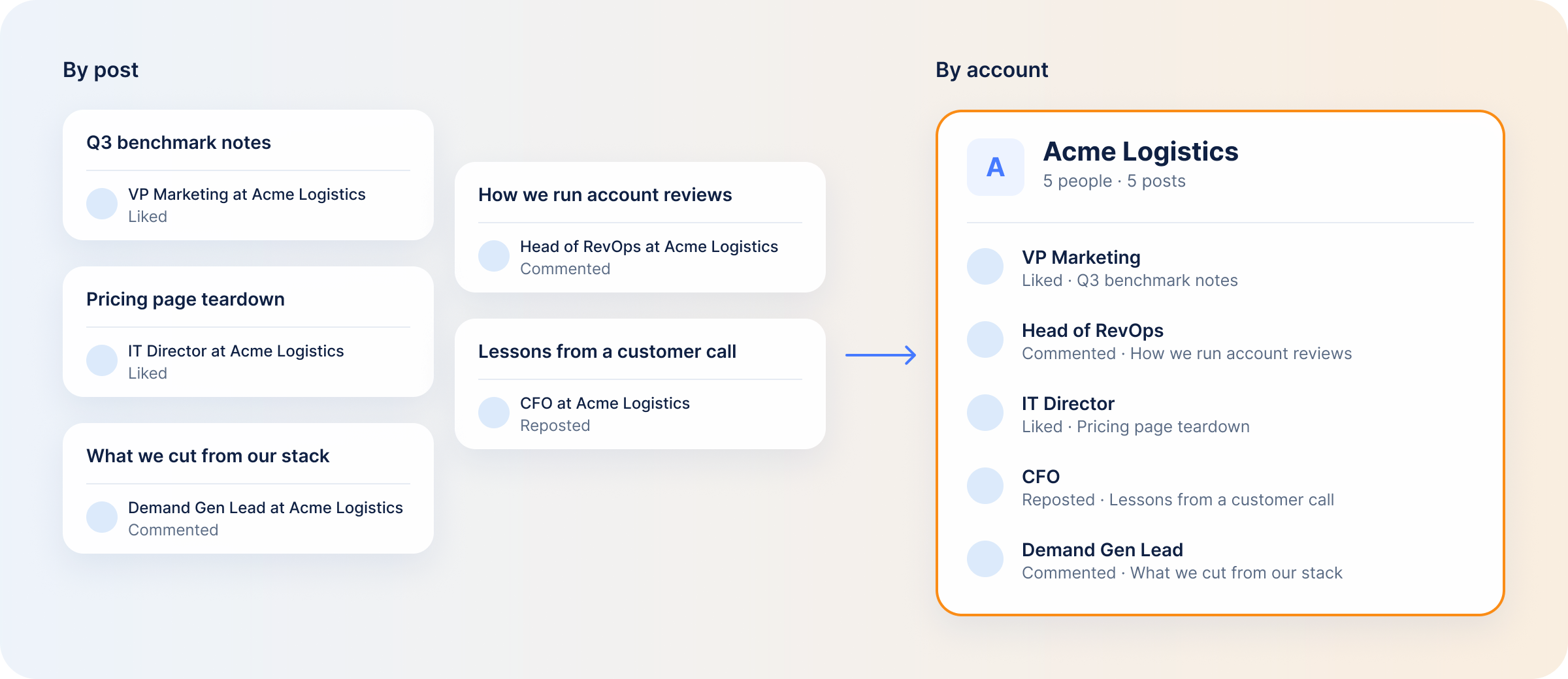
Once engagement is visible by account, you can run the same plays an ABM strategy does. Put more budget behind accounts already engaging, since they’re closer to a sales conversation than a cold account is. Stop spending on accounts that have already closed. Send accounts that engaged repeatedly but never converted to sales, because that list is warmer than almost anything outbound produces. And retire content themes that keep pulling in engagement from the wrong job titles. This week, pull your top engaged accounts from the last 30 days and route each one to more spend, sales or suppression.
Some formats suit B2B buyers better than others, and each does a different job:
Social does a different job at each stage of a B2B deal, and the signal that it’s working changes with it.
Top of funnel (TOFU). The job is brand awareness: getting a target account to recognize your name before they’re actively solving the problem. Original data, industry commentary and founder or employee posts do this well because they ask for nothing in return. The signal is reach into net-new accounts, meaning people from companies you weren’t engaging before.
Middle of funnel (MOFU). The job shifts to education and credibility. Teardowns, how-tos and customer stories work best here, since a buyer comparing solutions needs proof. The signal is the same accounts, and the same names, engaging across several posts.
Bottom of funnel (BOFU). Social rarely closes a deal. It keeps you visible while procurement, legal and internal sign-off run on their own timeline, which can take months, so content here should reinforce the credibility you’ve already built. The signal is engagement from the evaluators and economic buyers in a buying committee you’ve already identified.
Post-sale. Advocacy, expansion messaging and, most usefully, customer stories become the content that drives awareness for the next account. The signal is customers sharing or commenting on your content without being asked.
B2B social media ROI gets measured in three layers, and most reporting never makes it past the first.
Activity is impressions, clicks, likes, comments and shares. It’s the easiest data to get and to put on a slide, but it doesn’t tell anyone whether the right accounts saw any of it.
Account measurement asks which target accounts engaged, and which of those then visited the website. This is where social starts connecting to named companies.
Pipeline is where the LinkedIn ads metrics that matter in a revenue conversation live: influenced opportunities, closed-won revenue, and Won ROAS, which weighs revenue against spend on deals that closed. Most teams report activity and, sooner or later, get asked about pipeline.
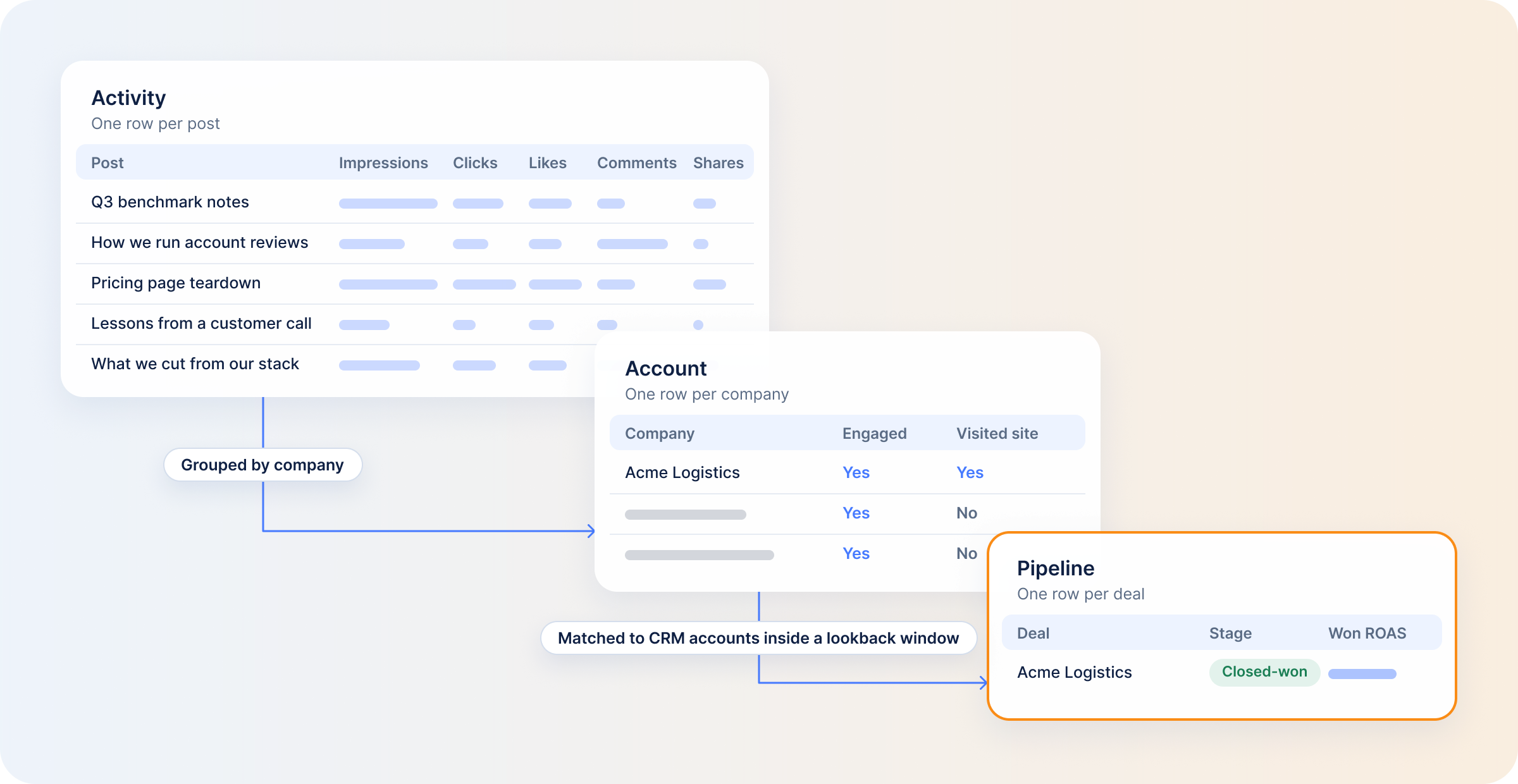
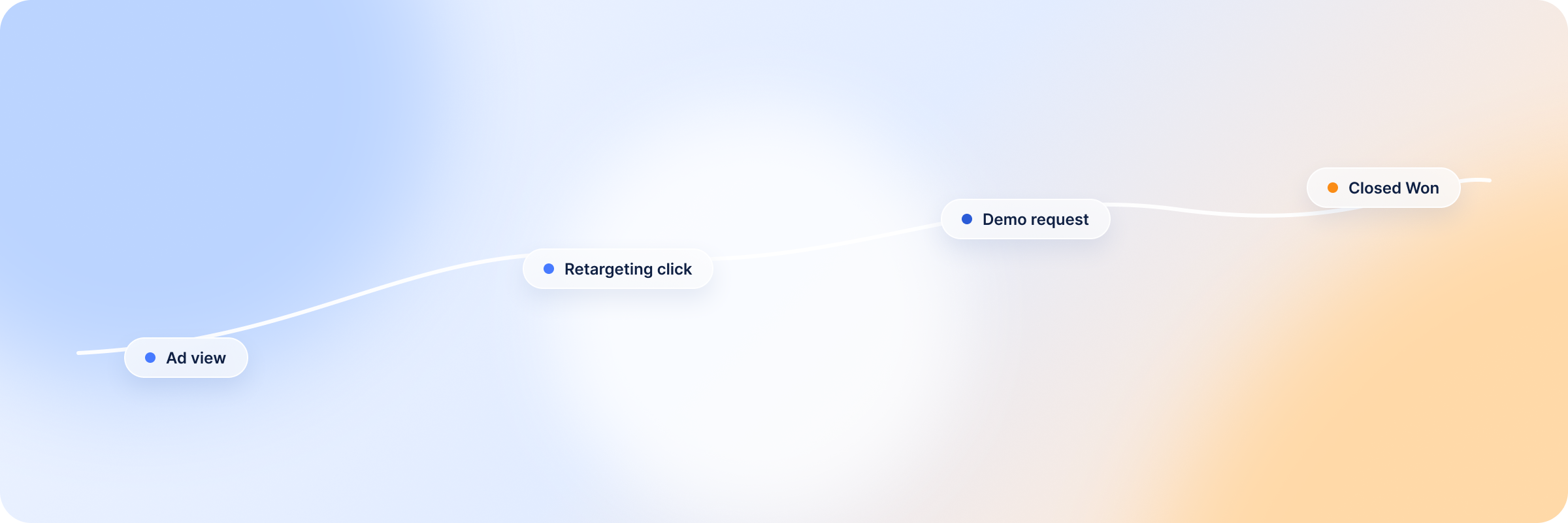
What connects the three layers is matching LinkedIn activity to CRM accounts inside a lookback window long enough to cover how slowly B2B deals move. With that match in place, a closed deal can be traced back to the social activity that came before it, which is how LinkedIn pipeline attribution works.
Attribution shows influence, a pattern where engagement came before progress. It can’t prove the engagement caused that progress, and treating it as proof is where a lot of over-claiming in this space starts.
A few habits separate a program that compounds from one that only generates activity:
AI helps in a few specific places in a B2B social workflow:
The place it doesn’t belong is the finished writing, especially thought leadership. It reads like what it is, and on a platform where credibility is the whole value, that costs more than the time it saves.
DemandSense measures what’s already happening on LinkedIn and connects it to revenue. It doesn’t publish or schedule posts, so it sits alongside whatever you use for that.
LinkedIn reports that a post did well. The CRM shows a deal appeared. Nothing in the post report says whether the two are related, which leaves marketing defending a number sales doesn’t recognize.
DemandSense tracks every paid and organic LinkedIn impression, click and engagement against the account it came from, which gives you a per-account journey from first impression to closed deal over a 3-, 6- or 12-month lookback. You decide what counts as influenced, with the Awareness, Engagement or Intent presets or your own thresholds. Accounts that engage heavily but have no deal in the CRM are listed separately, so sales can see who your content reached that nobody has spoken to yet. And Sensor Pixel, DemandSense’s website visitor identification, shows the companies and people your LinkedIn presence brought to the site who never filled in a form, each scored against your ICP.
Try DemandSense on your own LinkedIn account, free for 30 days — no card needed.
Influence typically shows up about one sales cycle after the engagement. That lag exists because an engaged account still has to go through its own buying process (evaluation, budget approval, internal sign-off) before it becomes an opportunity. Judge results against your sales cycle length, not the calendar.
Yes, and this is where click-based measurement falls short. LinkedIn’s benchmark CTR is 0.52%, so more than 99 in 100 ad impressions end without a click. Judging LinkedIn on clicks alone measures a sliver of its effect. View-through attribution credits the conversions that follow an ad someone saw but didn’t click.
Both, because they do different jobs. The company page is the credibility check a buyer runs to confirm the business is real and active. Employee profiles are where reach happens. Treat the page as the baseline every company needs, and profiles as the growth channel worth investing in.
As often as you can keep up at good quality for a full quarter. There’s no universal number. A better check than post count is whether the same target accounts keep showing up in your engagement.
At the account level, yes. At the channel level, no. Organic and paid reach the same buying committee, so splitting them at the account level credits whichever touch happened to land last. In practice, that means one account view across paid and organic, and a separate cost view per channel.
Start with Campaign Manager’s Companies Hub, which breaks paid and organic engagement down by company, so you can tell whether eleven engagements came from eleven accounts or one buying committee. It only covers LinkedIn. To see which of those accounts visited your site or have a deal open, match the engagement to accounts in your CRM.
Get expert insights and strategies delivered to your inbox weekly.
Book a personalized demo and discover how we can transform your B2B marketing.
See a quick demo video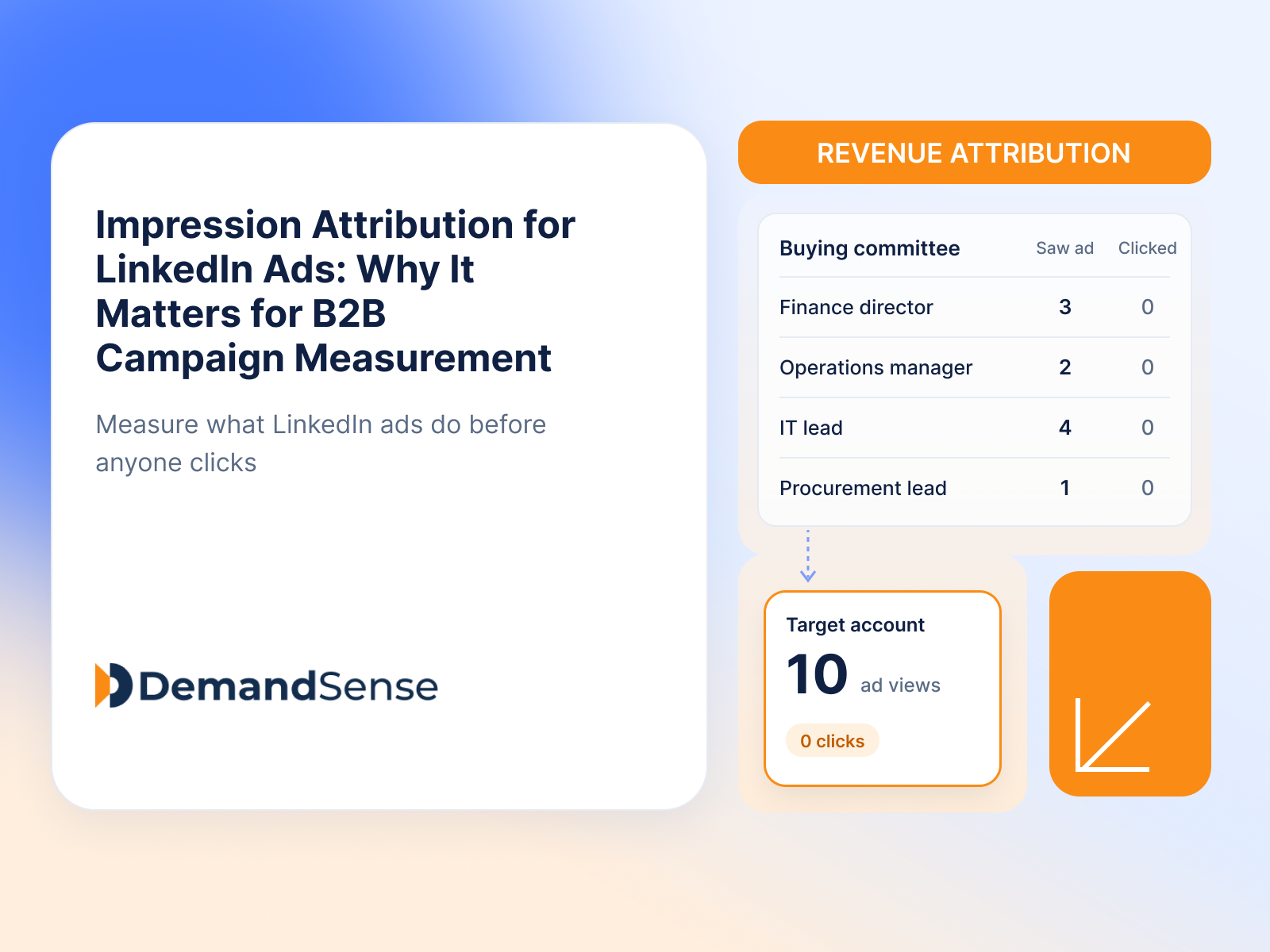
LinkedIn Ads
Revenue Attribution & Measurement
How LinkedIn impression attribution works, how it differs from click and view-through attribution, and what it reveals about B2B campaign performance.
LinkedIn Ads
Revenue Attribution & Measurement
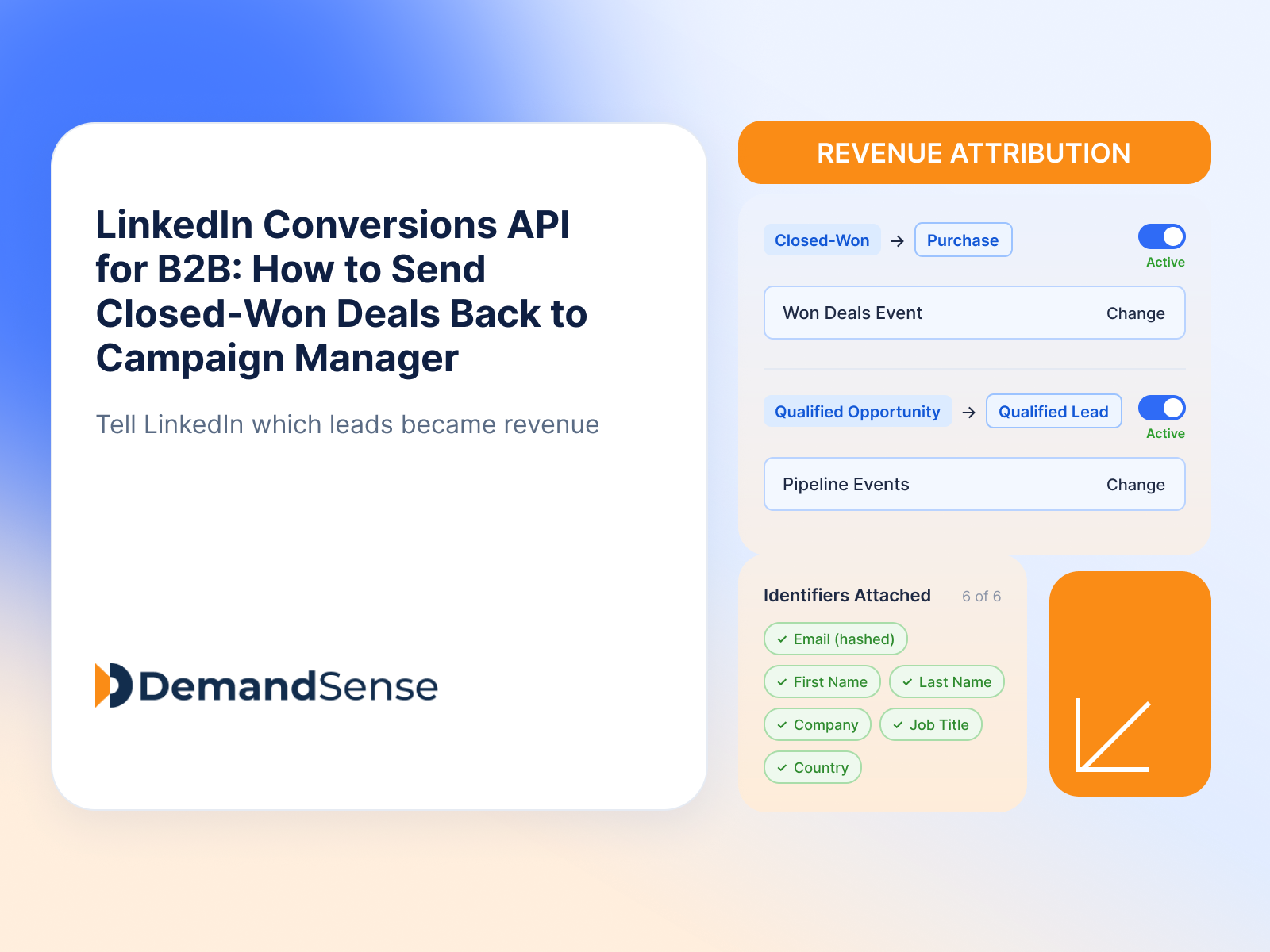
How the LinkedIn Conversions API works, what to send, how it fits with the Insight Tag, and how B2B teams get closed-won deals into Campaign Manager.
LinkedIn Ads
Revenue Attribution & Measurement
Learn how to turn LinkedIn Ads reporting into a B2B revenue dashboard that connects campaign performance with CRM data, pipeline, revenue, and ROAS.