LinkedIn Ads
LinkedIn Matched Audiences: Why They Underperform and How to Fix Them
LinkedIn Matched Audiences often match less than you expect. How match rates work, why lists stall under 300, and what to fix before you launch.
LinkedIn Ads
Revenue Attribution & Measurement
LinkedIn campaigns generate large impression volumes against a defined account list, but click-based reporting often credits conversion only to the most recent ad click, making your LinkedIn campaigns look less influential than they actually are.
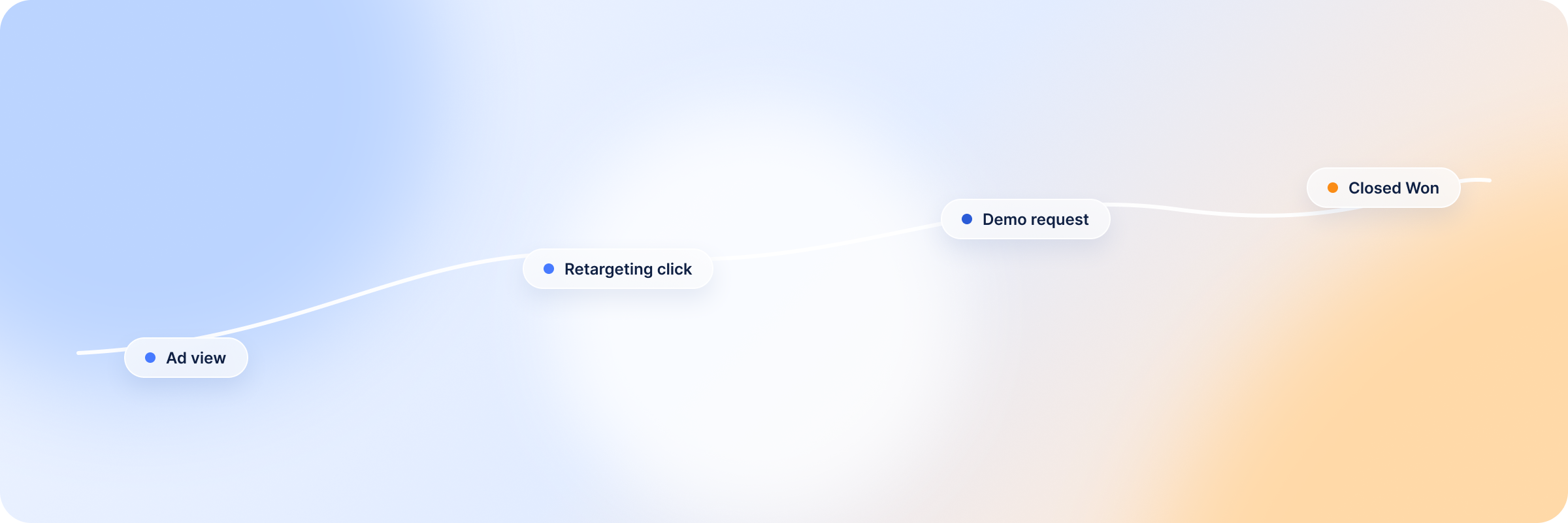
In reality, buyers may have been interacting with your ads for weeks before they convert through direct or branded search channels. They may not have clicked on the ad, but that does not mean they did not get the message or didn’t notice your brand.
View-through attribution (VTA) helps you account for that exposure by connecting conversions to the ads the buyer viewed even when they did not click on the ad. It acknowledges the role of your LinkedIn campaigns in the buyer’s journey; however, it does not necessarily prove that a specific ad is the reason someone bought your product.
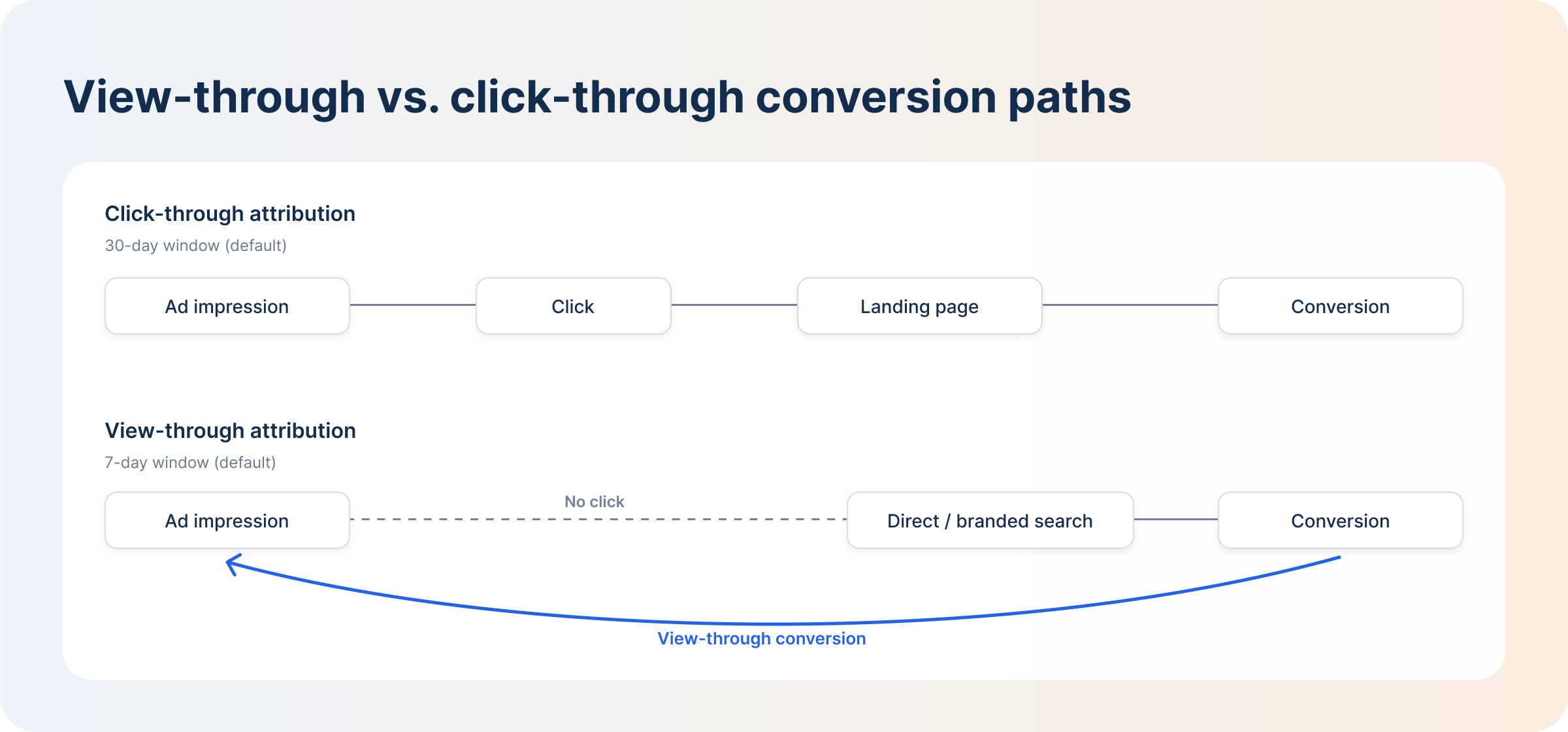
LinkedIn view-through attribution credits a conversion to an ad impression the user saw but did not click, within a set conversion window.
So when a user views your ad and scrolls past it without clicking but comes back to your website within the set lookback window (1-day, 7-day, 30-day or 90-day) and completes a desired action like filling out a form or downloading content, LinkedIn Insight Tag traces the user’s steps back to the ads they saw and awards “view-through” to that ad.
This gives LinkedIn marketers a better view of how their ad campaigns are performing than click-through attribution, which only credits ads for conversions that occur after a click.
Here’s how the two attribution models differ:
| Interaction | Attribution Trigger | Conversion Path | Best Use Case | Main Limitation | |
|---|---|---|---|---|---|
| View-Through Attribution (VTA) | A prospect sees your ad but does not take any action immediately | Ad view/impression | Ad view → No clicks → Later converts through other channels, e.g., direct/search | Top-of-funnel campaigns, ABM campaigns | Can over-credit ads for conversions that would have happened eventually |
| Click-Through Attribution (CTA) | A prospect clicks on your ad and completes a desired action | A click | Click → Landing Page visit → Website conversion | Direct response campaigns, lead generation campaigns | It ignores every other touchpoint and gives full credit to the final touchpoint |
Choosing one model over another leaves you with data blind spots, so you should use both models simultaneously to see the campaigns that buyers are exposed to and the ones that interest them enough to earn their clicks.
VTA benefits marketers in the following ways:
Every time you measure the success of your LinkedIn ads based on clicks, you make decisions on half-truths — here’s why:
B2B sales cycles are long, and deals involve 6–10 stakeholders who do their research and interact with your ads and content individually, most times without clicking or taking any actions. One might visit your website after seeing your ads, another downloads your industry report, and when they are ready to buy, only one of them will book a demo or reach out to your sales team directly. If you only track clicks, you will miss the fact that the other decision-makers saw your ads and were influenced by them.
Even though VTA does not prove that the buyers converted because of the campaigns, it gives you a more accurate view of the customer’s journey and helps you see the role your LinkedIn ads played in nurturing the accounts.
Marketers stay away from running LinkedIn campaigns because of the following misconceptions:
That LinkedIn is simply “expensive”
Advertisers see LinkedIn’s average CPC — $5.59 across B2B campaigns, per DemandSense’s 2025 benchmark data — next to cheaper clicks on Google or Meta and conclude that LinkedIn is expensive, but in reality, these platforms operate differently and bring different values to the table.
LinkedIn puts your brand in front of a niche professional audience, which you can narrow down further using firmographic filters like job function and seniority to reach your ICP, but since many people rely on the platform’s last-click attribution model and remain blind to how LinkedIn ads influence pipeline, they conclude the campaigns did not work and feel like they wasted their ad spend.
LinkedIn is only a click/signup channel
LinkedIn is a display advertising channel whose main duty is to give you visibility with your target audience and help you create demand. If you approach it as a signup channel, you will be disappointed because of the 95/5 rule — that at any given time, only 5% of your LinkedIn audience are looking to buy. LinkedIn helps you nurture the 95% so when they are ready to buy, they think of you.
LinkedIn is purely top-of-funnel
Yes, LinkedIn is good for TOFU campaigns because it helps you create demand, but you can also use it to capture demand through Lead Gen Forms. It all depends on the campaign goal you want to achieve.
LinkedIn’s view-through conversion involves three key components: ad impression, lookback window and conversion matching.
An ad impression is recorded as a viewable impression when at least 50% of the ad is displayed on a user’s screen for one continuous second on desktop, or 300 milliseconds on mobile, for Sponsored Content.
When that user shows up on your website days later and completes a desired action like filling out a form or clicking on the “Book a demo” CTA button, the Insight Tag identifies the visitor using cookies.
Due to the heavy data restrictions that block third-party cookies, the Insight Tag tracking is limited. You should also use LinkedIn’s Conversions API as your data source because it sends your conversion data directly from your server to LinkedIn’s server for more accurate view-based matching.
LinkedIn then matches the visitor to the ads they saw before converting, depending on the set lookback window and counts the conversion as a view-through conversion. The conversion window is configurable — 1, 7, 30 or 90 days — and defaults to 90 days for both click-through and view-through conversions.
Remember: LinkedIn still operates on a last-touch attribution model and prioritizes clicks over views. So if a user viewed an ad and later on clicked on the ad, LinkedIn records that as a click-through conversion — it only qualifies as a view-through conversion if the user never clicks the ad.
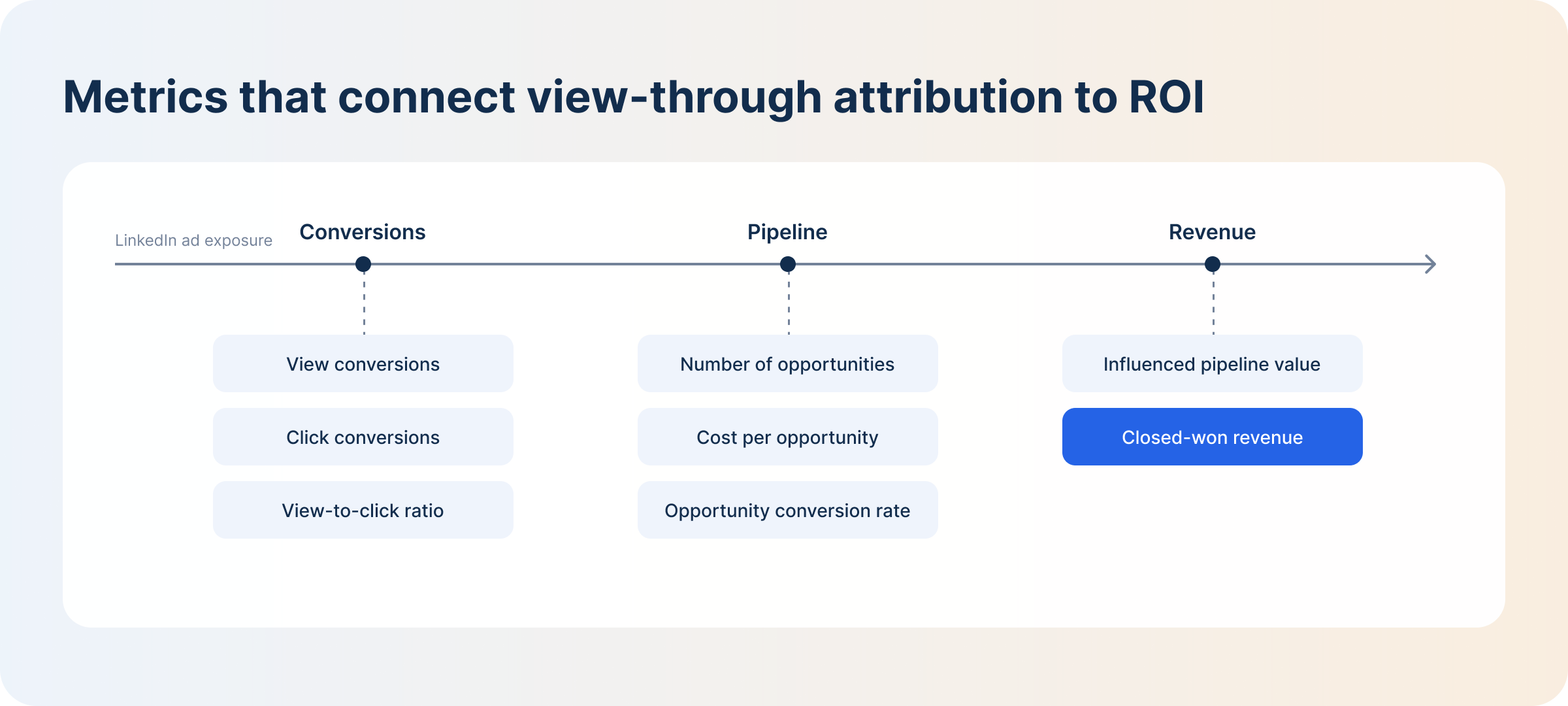
View-through attribution is not proof of incrementality, but if you analyze it alongside the following metrics, you can connect VTA to ROI.
The VTA stops at the set LinkedIn conversion window. It cannot tell you whether those conversions turn into open opportunities in pipeline or if those users eventually become paying customers.
This leaves you with an incomplete view of the buyer’s journey — you can’t retrace the buyer’s steps from the first ad impression to pipeline opportunity to closed-won deal because the lookback window can go to 90 days (365 days for certain offline conversion categories uploaded via the Conversions API or CSV), while B2B deals can take over six months before closing.
Campaign Manager gives you contact-level reporting yet B2B deals involve buying committees with multiple stakeholders; hence, it’s hard to see how the stakeholders from each account interact with your campaigns, especially when running ABM campaigns.
And when paid and organic LinkedIn activity live in separate reports, marketers can’t see the compounding effect of their LinkedIn efforts.
Multi-touch attribution platforms give you better, more complete insights into how accounts interact with your ads and progress down the buying funnel than LinkedIn’s native attribution.
Is 300 milliseconds really enough for a campaign to influence conversion or a buyer’s decision? LinkedIn’s VTA credits every campaign the buyer saw regardless of whether the campaign influenced their conversion or not.
DemandSense lets you decide what counts as marketing influenced based on three presets (Awareness, Engagement, Intent) so you don’t over-credit campaigns. You can set your attribution window to 3, 6 or 12 months depending on how long your sales cycles are and track most of your buyer’s journey beyond the conversion.
It connects your LinkedIn data to your CRM (HubSpot, Salesforce, Attio), bringing your paid and organic LinkedIn activity into one view. You get account-level engagement metrics like influenced pipeline, won ROAS and closed-won revenue that make your LinkedIn revenue attribution easier and more accurate.
Once an account closes, Spend Protection automatically excludes them from retargeting so you don’t waste your ad budget on them.
Wait at least one to two weeks for the ads to drive impressions and reach more of your target audience. B2B buyers rarely convert immediately after they see ads, so measuring view-through performance too early might make you think your campaigns are failing even when they are already warming up the audience.
Yes, frequency can influence view-through conversions because the more a user is exposed to your ads, the more they familiarize themselves with your product and they may eventually convert. Keep an eye on your frequency, though, as too much exposure leads to ad fatigue.
Last-click reporting gives full credit to the final touchpoint before conversion and ignores all the other instances where the buyer interacted with your LinkedIn ads, making your campaigns look bad.
DemandSense connects all your LinkedIn activity to your CRM, enabling you to see how your LinkedIn campaigns actually influence the buyers from first touch to last touchpoint.
Account-level attribution is more useful when measuring ABM campaign performance. Marketers need to be able to monitor how much their ads have penetrated the buying committee members and see whether they are reaching the right people at the target accounts.
VTA shows correlation, not incrementality. A buyer might have already made up their mind to convert and only stumbled upon your ads coincidentally. This does not mean that the ads influenced their decisions in any way but VTA will still count this as a view conversion. To measure incrementality, you need a holdout or geo test.
B2B buyers spend months researching products — often across a 6–10 person buying committee — before they ever talk to your sales team, and last-touch reporting misses all of that research because it only looks at the most recent conversion.
VTA attributes conversions to the ads the buyer saw along the way even when they never clicked the ads, giving marketers a better view into the buyer’s journey.
Book a personalized demo and discover how we can transform your B2B marketing.
See a quick demo videoLinkedIn Ads
LinkedIn Matched Audiences often match less than you expect. How match rates work, why lists stall under 300, and what to fix before you launch.
LinkedIn Ads
A complete guide to LinkedIn targeting: every ad targeting option, retargeting and matched audiences, ABM targeting, and how to keep audiences converting.
LinkedIn Ads
Compare LinkedIn Conversation Ads and Message Ads: how each format works, which fits your campaign, and how to measure them beyond opens and clicks.
Get expert insights and strategies delivered to your inbox weekly.
