
Tools & Comparisons
Visitor Intelligence
DemandSense vs Vector: Pricing, Use Cases, and Key Differences
DemandSense vs Vector after Vector’s September 2026 relaunch: account stages, ad audiences, deal stories, the Conversions API, MCP and pricing.
Tools & Comparisons
Visitor Intelligence
Most of the traffic your team works to bring in reads two or three pages, leaves without filling in anything, and lands in the analytics dashboard as a number.
Some of those visits matter more than others. A company that reads your pricing page, comes back on Thursday and works through your security documentation is behaving like a buyer. You have no name to put against the behaviour.
Website visitor tracking closes that gap. It records what visitors do, and with the right tool it resolves a share of that traffic to the companies and people behind it, so anonymous sessions become accounts sales can work.
B2B lead generation is the work of finding potential buyers, earning their interest and moving them toward a sales conversation. Traditionally that has meant form fills, content downloads, demo requests, events and referrals, all of which produce a name and an email address.
Modern buyers do most of their evaluation before any of that happens. They read comparison pages, check pricing, ask peers, and contact sales only once a shortlist exists.
Website visitor tracking sits in that gap, telling sales and marketing which anonymous traffic deserves attention and what those visitors were reading.
A company that matches your ICP, visits your pricing and security pages twice in a week and appears nowhere in your CRM is a lead, even though nothing in your marketing automation will ever record it as one.
Visitor identification software resolves those sessions to a company and links them to the pages viewed, which lets you identify accounts ready to buy while they are still evaluating rather than after they have shortlisted somebody else.
Pricing, comparison, integration and implementation pages are where evaluation happens, and a repeat visit to one is worth more than a first visit to your homepage. Audit them for:
What you ask for should match what the visitor gets back. Twelve fields in front of a technical guide will cost you completions; twelve in front of a demo request filter out people who were never going to buy, which is the point of them.
Keep required fields to the minimum the offer justifies, usually a work email and a name, and let enrichment fill in the rest.
Not every visitor is a sales lead. Plenty arrive to understand a problem they have only just named, and pushing them into a sales conversation ends the relationship early. Segment by what they read and follow up with more of it: research reports, templates, benchmark data, webinars.
There are also ways to nurture website visitors that never touch an email address, which matters when you have the account but no contact inside it.
Identification without routing is a dashboard nobody opens. Decide in advance what happens when a signal fires: pages viewed, visit count, ICP fit, CRM status and prior engagement can all tier an account automatically.
A tier-one account returning to a high-intent page should reach a rep’s queue with its page history attached. One that fits but isn’t ready belongs in a LinkedIn retargeting audience built from site behaviour, not a job-title filter.
Google Analytics and its equivalents answer their own question well: how many people came, where from, what they looked at, how many converted. For traffic and content decisions that is the right instrument, but it stops short of lead qualification for three reasons:
You need both: analytics for how traffic behaves in aggregate, identification for which accounts are behind it.
Named accounts instead of session counts — the traffic report becomes a list of companies you can look up, qualify and act on.
An earlier read on buying intent — page paths and repeat visits show how far along an account is well before it identifies itself.
A sales queue ordered by fit — reps work the accounts that match your ICP first, rather than whichever lead arrived most recently.
Retargeting audiences built from behaviour — the accounts that read your comparison page make a better audience than a broad job-title filter.
Campaign decisions grounded in who showed up — you can see which campaigns brought in accounts worth having, not only which brought in the most clicks.
These are four layers rather than four competing products. Each answers a different question, and only one of them produces leads out of anonymous traffic.
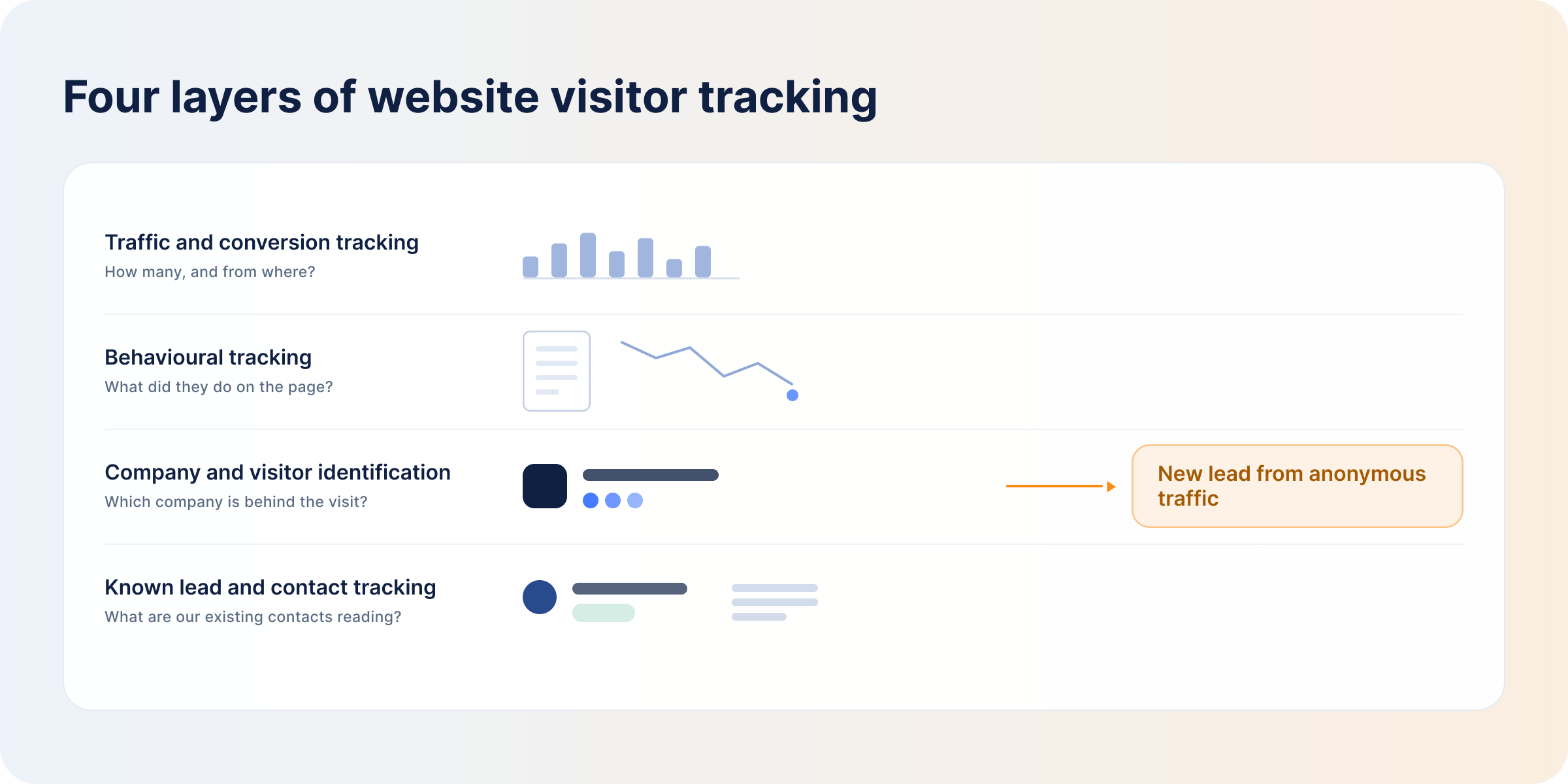
The volume layer. It answers:
What visitors do once they arrive: pages viewed, time on each, scroll depth, repeat visits, and the points where they hesitate. Session recordings and heatmaps sit here.
It is diagnostic rather than commercial. If most visitors abandon the pricing page halfway down, that is a message about the page.
The layer that produces leads. It resolves a visit to an organisation, usually through IP-to-company matching and firmographic data, and returns a company name, industry, size and location. Some tools go further and resolve individuals, which is geographically narrower and depends on the consent in place.
This layer is the mechanic behind most attempts to turn anonymous visitors into sales opportunities.
For people already in your CRM. First-party cookies tie site behaviour to a known record, so you can see what a contact read before a call and score the account on current activity rather than the date it first converted.
Seven tools, compared on what matters most: whether they name a company, a person, or both. Everything below was checked against each vendor’s own documentation on 4 September 2026. Coverage and pricing change often, so confirm before you buy.
| Tool | Identification Level | Intent & Behavior Signals | CRM Integration | Lead Activation | Best For |
|---|---|---|---|---|---|
| DemandSense | Company and person | ICP fit scoring, lead scoring on visitor behaviour | HubSpot, Salesforce, Attio; webhooks for others | Push matched visitors to LinkedIn as a custom audience; self-filling suppression list | B2B teams running LinkedIn ads who want identification tied to campaigns |
| Leadfeeder (formerly Dealfront) | Company | Pages viewed, visit duration, fit and intent scoring | HubSpot, Salesforce, Pipedrive, Zoho | CRM tasks; LinkedIn Matched Audience sync on Activate and above | European teams working inbound leads |
| ZoomInfo WebSights | Company, with decision-maker contacts from ZoomInfo data | Site activity inside the ZoomInfo GTM platform | ZoomInfo GTM platform, Salesforce, HubSpot | Pushes activity into connected sales tools | Enterprise teams already on ZoomInfo |
| Lead Forensics | Company (IP-based), with decision-maker contacts from its own database | Page views, visit history | Salesforce, HubSpot, Dynamics 365, Pipedrive, Zoho | Outbound sequences off identified accounts | Mid-market outbound sales teams |
| RB2B | Person (US only) and company (global) | Page views, new versus returning visitors | HubSpot, Salesforce; Zapier and webhooks | Pushes named visitors to Slack or Teams | US outbound teams that need contact names |
| Factors.ai | Company; person-level is a paid add-on powered by RB2B (US traffic) | Multi-touch journeys, G2 intent signals | HubSpot, Salesforce, Zoho | LinkedIn and Google Ads audience sync | Teams pairing identification with multi-touch attribution |
| Snitcher | Company, with a contact-level identity layer | Sessions, page views, first and last visit | HubSpot, Salesforce, Pipedrive, Zoho, Dynamics, Attio, Close | Slack and email visitor reports | Small teams wanting a low-cost starting point |
How each one fits:
Five questions, in the order that usually decides it:
Knowing who is on the site is half of it. What happens next is the other half, and that is where most identification tools hand the problem back to you.
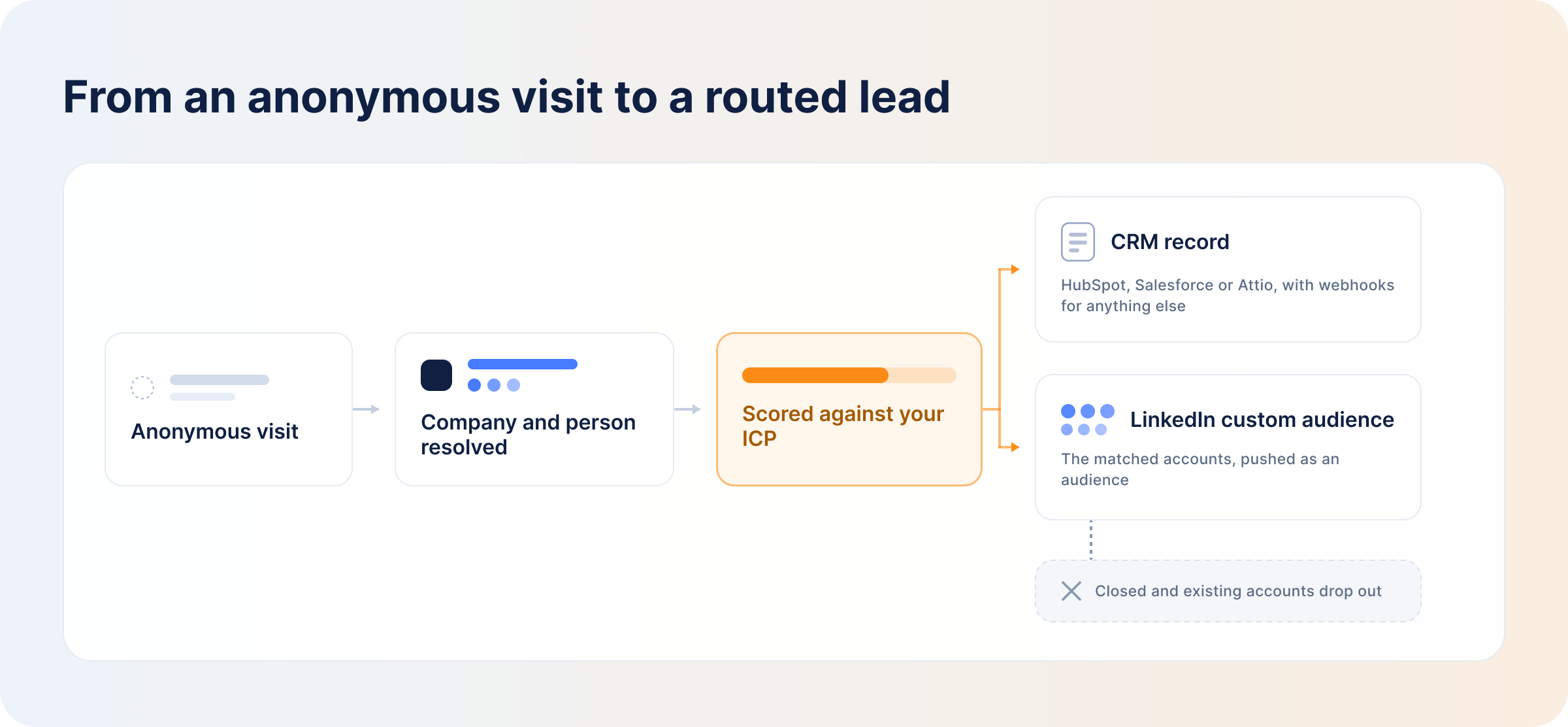
The DemandSense Sensor Pixel identifies anonymous visitors at company and person level and scores each one against your ideal customer profile automatically, so sales sees fit rather than names to research. You can layer your own scoring rules on top, combining fit with engagement, and scores decay, so an account that went quiet three months ago doesn’t stay at the top of the queue.
Identified accounts sync to HubSpot, Salesforce or Attio, with webhooks for anything else. Accounts matching your ICP can be pushed to LinkedIn as a custom audience, the most direct of the use cases for visitor identification with LinkedIn Ads, and a global suppression list fills itself so customers and closed deals drop out of your targeting.
Because the same platform holds your LinkedIn ad activity and your CRM deals, a site visit becomes a touch in the account’s journey rather than a row in an analytics report. Installation runs through Google Tag Manager, without a developer ticket.
Both, but not equally. Nearly every tool can identify companies visiting your website, and it works globally, because company data is not personal data. The methods that identify website visitors as individuals are narrower, and several vendors restrict them to US traffic.
It depends on your traffic, so the honest answer is a range rather than a number. Company-level identification resolves more visitors than person-level, and B2B office traffic resolves best, while remote workers and consumer ISPs resolve worst.
Vendors publish their own figures, each measured on their own traffic with their own definition of a match; Leadfeeder declines to publish one at all. The number that means most is the one from a trial on your site.
Yes. That is the reason it exists. The tool matches the incoming connection and device signals against company and identity data licensed from data providers, and returns whatever resolves. No form submission is needed for company-level identification.
Both teams get the same picture: which accounts are on the site, what they read, how often they come back. Marketing builds audiences from it; sales decides who to contact and what to open with. One caution: a single visit to a pricing page is not a buying signal.
Tracking is about behaviour: what visitors do on your site, in aggregate. Identification is about identity: which company, and sometimes which person, is behind a visit. Identification is the subset that makes the rest actionable, because behaviour tells you which pages need work and identity tells you which accounts to follow up.
Install a visitor identification tool so anonymous sessions resolve to companies, then score those accounts on fit and on what they read. Route the high-fit ones to sales with the page history attached, and put the rest into a retargeting audience. Then fix the pages those accounts spend most time on.
Book a personalized demo and discover how we can transform your B2B marketing.
See a quick demo videoTools & Comparisons
Visitor Intelligence
DemandSense vs Vector after Vector’s September 2026 relaunch: account stages, ad audiences, deal stories, the Conversions API, MCP and pricing.
LinkedIn Ads
Tools & Comparisons
DemandSense vs Linklo on scheduling, exposure control, A/B testing, visitor identification and price — two tools that overlap on delivery and split after it.
Tools & Comparisons
Visitor Intelligence
DemandSense vs RB2B on person-level identification, campaign context, alerting, ICP scoring, attribution and real pricing across every tier.
Get expert insights and strategies delivered to your inbox weekly.
