••
Insights & Resources
Expert strategies, case studies, and best practices for B2B marketing teams.
Expert strategies, case studies, and best practices for B2B marketing teams.
LinkedIn Ads
Revenue Attribution & Measurement
Most B2B teams can name their highest-value accounts. Sales already has the list — the 150 or 200 companies where a closed deal would move the quarter, where the buying committee is known, where the deal size justifies real investment. What breaks down is what happens next: that named list gets handed to a campaign that targets “VP of Marketing, SaaS, 200–1,000 employees” and treats every account on it identically to every account off it.
ABM prospecting is what fixes that mismatch. It’s the practice of building LinkedIn ad campaigns around a specific, named account list rather than a broad persona, so spend, creative, and targeting all map to accounts sales actually wants, not a lookalike segment that happens to fit the ICP. It’s the paid layer that makes sure the right accounts see you before an SDR ever sends a first email.
ABM prospecting turns a static list of target accounts into a live LinkedIn campaign, then closes the loop by feeding what happens in that campaign back to sales. The steps below are how ABM prospecting works, from list to handoff.
ABM prospecting is the practice of running LinkedIn ad campaigns against a named list of target accounts instead of a broad audience defined by title and industry. It’s the execution layer of ABM strategy that turns a target account list into live campaigns.
It’s easy to confuse with broad demand gen. Demand gen builds an audience from firmographic and persona filters and lets LinkedIn’s targeting find whoever fits; ABM prospecting starts from a fixed list of companies and builds the audience around them.
It also gets confused with account-based sales, which covers the same accounts but a different motion. Account-based sales is outbound — SDRs sequencing emails and calls against target accounts. ABM prospecting is the paid layer running in parallel, warming those same accounts before or alongside that outreach. Good account-based intelligence, drawn from firmographic data, intent signals, and engagement history, is what determines whether an account belongs on the list at all.
LinkedIn has three things no other ad platform offers together: company-level targeting that doesn’t rely on third-party cookies, job title and seniority data that maps directly onto a buying committee, and Matched Audiences that let you upload an account list and target it directly. Google Ads can chase keyword intent. Meta can target by interest. Neither can guarantee an ad only reaches people at a defined set of companies, filtered further by whether they’re a Director or a VP.
That precision is also why the cost is defensible instead of just high. LinkedIn CPCs regularly run well above Meta or Google display, and teams that run LinkedIn like a broad-reach channel burn budget fast without much to show for it. The complaint shows up constantly in practitioner circles: high spend, thin conversion rate, no clear read on what’s actually working. That complaint is almost always a targeting problem, not a platform problem. Spend $10,000 reaching a persona at 50,000 companies and most of it goes to people who were never going to buy. Spend the same $10,000 reaching decision-makers at a few hundred named accounts and every impression has a reason to exist.
The fastest way to build a target account list isn’t to start from a list of criteria. It’s to start from your closed-won accounts and work backwards.
Pull the last 20 to 30 deals that closed well: good deal size, short sales cycle, and no churn in the time since. Look for what they actually share, not what you assumed they’d share. Common patterns worth checking:
Once those shared attributes are clear, run them against your full prospect database to surface companies that look like the accounts that already worked, plus your current customer base for expansion potential in accounts already proven to buy. That combined output becomes your target account list. From there, account scoring and tiering decides how much investment each account gets.
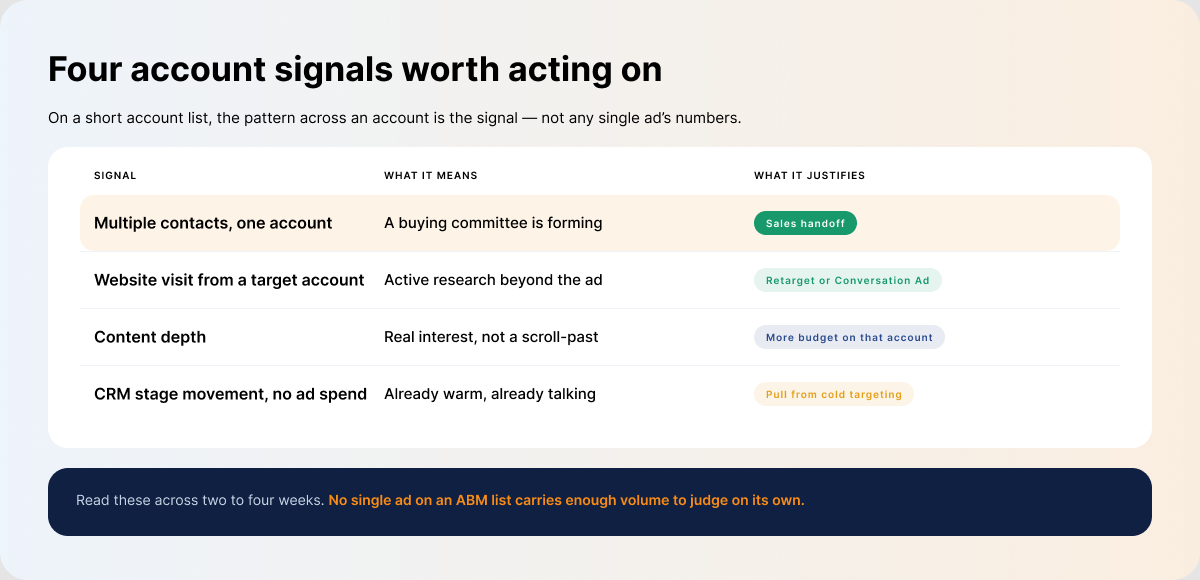
A normal LinkedIn campaign targets tens or hundreds of thousands of people, and generates enough clicks in a week or two that the numbers can be trusted. ABM prospecting doesn’t have that volume. The whole point is targeting a short list, so a single ad might get 15 clicks in a week instead of 1,500 — not enough to tell the difference between “this ad genuinely performs better” and “this ad got lucky.”
So you read accounts, not ads. Four buyer intent signals are worth watching:
The discipline is reading patterns across an account over two to four weeks, not judging any single ad’s performance in isolation.
Here’s a detailed step-by-step guide to building an ABM prospecting campaign on LinkedIn.
A typical B2B deal involves six to ten stakeholders, not one decision-maker, and enterprise deals routinely run higher once security, legal, and procurement are involved. Before building any audience, identify four roles inside each target account:
Each role translates into a specific LinkedIn job function and seniority combination. Economic buyers map to Director-plus seniority within Marketing, Sales, or Finance functions. Technical evaluators map to IC or Senior seniority within Engineering or Operations. Building the audience role by role, instead of one broad “decision-maker” filter, is what makes multi-persona targeting possible later in the campaign.
To build a Matched Audience, upload the account list (CSV or synced CRM data) and let LinkedIn match it against its company page database, a process that takes up to 48 hours. Match rates vary depending on list quality and how many companies maintain active LinkedIn pages.
One constraint shapes everything downstream: LinkedIn requires at least 300 rows in an uploaded company list, and recommends 1,000 or more for reliable matching and delivery. A 50-account Tier 1 list cannot be uploaded as a Matched Audience on its own. You have two workable options — upload the full account list as one audience and separate tiers using campaign structure and creative rather than separate uploads, or reach the smallest tier through Campaign Manager’s native company-name targeting, which lets you add companies individually without hitting the list minimum.
Within that constraint, build multiple smaller Matched Audiences rather than one large one wherever volume allows. Combining every tier and every role into a single audience defeats the purpose of ABM prospecting, since it removes the ability to vary budget, format, and messaging by segment.
Set goals by tier, not by campaign template. Tier 1 accounts, few in number and high in deal value, warrant goals centered on awareness and coverage across the full buying committee, even if that means lower immediate conversion. Tier 3 accounts need efficiency-focused goals, since the return per account is smaller and the spend has to reflect that.
The failure mode is optimizing all tiers to the same conversion rate benchmark. That treats a Tier 1 account, where the win is five stakeholders recognizing the brand before a long cycle closes, the same as a Tier 3 account, where the win is cheap and fast engagement. Different economics need different goals.
Ad format should shift as an account moves through the buying stage. Cold accounts see Thought Leader Ads and video formats built for awareness rather than a direct ask. Accounts showing early engagement move to Document Ads and case studies, formats that build credibility with proof points. Accounts already warm see conversion-focused formats designed to capture a form fill or a meeting request.
Same account, different pain, depending on who’s reading the ad. A VP of Marketing cares about pipeline impact and campaign ROI. A Head of RevOps cares about data cleanliness and workflow integration. A Security lead, often a blocker, cares about compliance posture and data handling. Writing one message and running it against every role wastes the targeting work done in step one, since the champion and the blocker rarely respond to the same argument.
Run separate campaigns per tier so budget, frequency, and creative can differ without one tier’s settings bleeding into another. Tier 1 gets its own campaign with higher budget and broader format coverage. Tier 2 and Tier 3 get lighter, more efficient setups. The tradeoff is that splitting one list into three campaigns means each campaign gets a smaller slice of total engagement and thinner data. Keep Tier 1 separate regardless, since it carries the most deal value. Merge Tier 2 and Tier 3 if either one alone can’t generate enough engagement to read.
Launch in stages, not all at once. Awareness content goes out first, across the whole account list. Retargeting kicks in for accounts that engage, moving them into more specific, proof-heavy content. Conversion asks come last, reserved for accounts already showing repeat engagement. Given how long B2B cycles typically run, often several months for larger deals, this sequence needs to be paced across the full cycle rather than compressed into a few weeks. Rushing an account to a conversion ask before it’s shown real engagement usually just burns impressions.
This is where ads and outreach have to work as one motion, not two competing ones. Sales needs three things from the ad campaign: which accounts have engaged, with what content specifically, and when. That data changes both outreach timing and the opener. An SDR reaching out to an account that’s watched three videos and clicked a case study can reference that engagement directly, instead of opening cold. An account showing no ad engagement yet might warrant more warming before outreach starts at all, rather than an SDR wasting a first touch on someone who hasn’t seen the brand yet.
The reverse matters too. Sales activity should feed back into the ad campaign. Once an account books a meeting or enters active conversation, pull it from cold prospecting formats to avoid redundant spend on someone already talking to a rep. Ads warm the account. Outreach converts it.
A Tier 1 list of 50 accounts can hit ad fatigue within days if budget and frequency aren’t capped deliberately. Set frequency caps low enough that the same stakeholder isn’t seeing the same ad five times in a week, and use dayparting to spread delivery evenly rather than letting the algorithm front-load spend early in the campaign. The risk with a tight, high-value list is real: burn through it too fast, and there’s no way to re-engage those same accounts without waiting out a cooldown period or shifting to entirely new creative.
Account-level engagement is the metric worth trusting: how many accounts are active, how many stakeholders per account, and whether that activity correlates with CRM stage progression. From there, tie engagement to pipeline attribution and revenue, closing the loop on whether the spend actually worked.
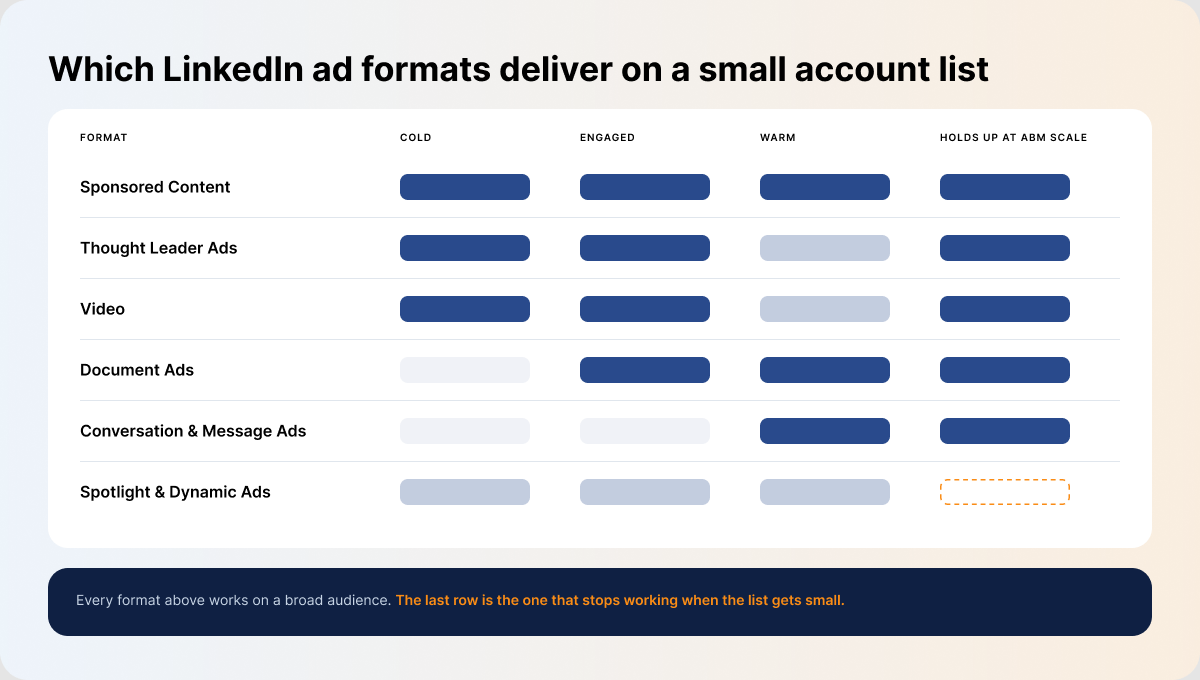
Format choice in ABM prospecting isn’t about your creative preference. It’s about which formats actually deliver at small audience sizes and which ones need volume to function.
Sponsored Content is the reliable default. In-feed, works across every tier, and doesn’t require a large Matched Audience to serve consistently. Almost every ABM campaign runs this as the base layer.
Thought Leader Ads boost a real employee’s organic post instead of brand content. On a tight account list, this tends to outperform standard ads because it doesn’t announce itself as advertising the way brand-page content does.
Document Ads put a case study, whitepaper, or deck directly in the feed for the account to flip through. Fits mid-stage best, once an account has engaged enough to warrant proof over pure awareness.
Video works at any stage and doubles as a signal source, since how much of a video someone watches is one of the more reliable indicators of real interest available at ABM’s small scale.
Conversation and Message Ads deliver directly to the inbox and belong late-stage only. Conversation Ads are the more useful of the two for ABM, since the branching structure lets one send serve different buying roles. Either format, sent to a cold account with no prior engagement, lands as unwanted outreach rather than a relevant touch, which undercuts the whole point of warming the account first.
Spotlight and Dynamic Ads personalize the creative around the viewer’s own profile, a good conceptual fit for ABM, but these formats depend on audience scale to serve efficiently and tend to underdeliver on the smallest, highest-value lists.
CTR and CPL are the default metrics for most LinkedIn campaigns, and they actively mislead on an ABM list — there simply isn’t enough volume for either number to mean much. Judge ABM prospecting on its own account-level ABM metrics, split into two categories.
Account-level metrics answer whether the campaign is reaching the right people at all:
Pipeline metrics answer whether that engagement is turning into revenue:
The comparison that makes this concrete: a thousand clicks from outside the ICP is a vanity number. Four stakeholders engaging at one target account, especially if they span different roles in the buying committee, is a far stronger signal that a deal is moving, even though the click count looks tiny by comparison.
Everything covered so far — account-level signals, buying committee mapping, small-list measurement — depends on being able to see which accounts engaged with which ads, and what that engagement was worth.
LinkedIn isn’t blind here. Campaign Manager’s Company Engagement Report shows impressions, members targeted, ad engagements and a coarse engagement level for the companies on an uploaded list. What it can’t do is tell you which content an account engaged with, surface engaged companies that weren’t already on your list, or connect any of it to a deal. That’s the gap.
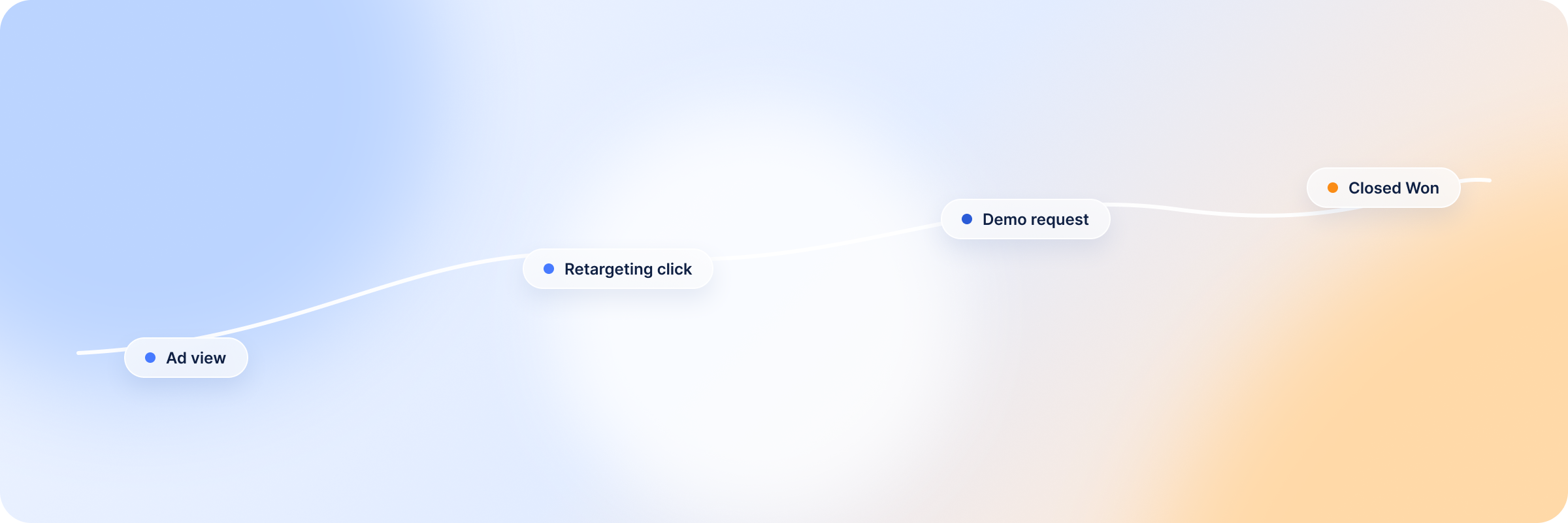
DemandSense gives company-level visibility into LinkedIn ad engagement, paid and organic in one view, and surfaces engaged companies well beyond the set Campaign Manager reports on. That feeds the Opportunity Gap list: accounts actively engaging with your ads but missing from the CRM entirely — the ones sales doesn’t know are already warm, which on a named account list is the single most actionable output you can get. Each account also gets a journey timeline, so the two-to-four-week engagement pattern described above reads as one continuous record rather than a set of disconnected campaign snapshots.
On the pipeline side, DemandSense connects that engagement to influenced pipeline and influenced closed-won revenue by campaign. You also decide what “influenced” means: three presets, or your own thresholds, rather than a vendor deciding on your behalf — which matters more in ABM than anywhere else, because a Tier 1 account that never clicks but watches three videos either counts or it doesn’t.
Two controls handle the operational side of a finite account list. Spend Protection pulls accounts out of cold targeting once they’ve entered active sales conversations, so you stop paying to advertise to a deal that’s already in flight. Frequency capping limits how often any one company sees your ads — the fatigue problem in step nine, solved without hand-building exclusion lists in Campaign Manager. Both run on a scheduled sync rather than instantly, which is worth knowing when you’re pacing a tight list.
ABM prospecting only works when the shift from volume to named accounts actually happens inside the campaign, not just in strategy decks. The teams getting this right aren’t chasing bigger audiences. They’re building smaller, sharper campaigns around the few hundred companies that actually move revenue, and reading account-level signals to know when sales should step in.
Start a free trial with DemandSense to see which of your target accounts are already engaging on LinkedIn.
There’s no ideal number, but there is a hard constraint: an uploaded LinkedIn company list needs at least 300 rows, and LinkedIn recommends 1,000 or more for reliable matching. Lists below that either can’t be uploaded at all or under-deliver once live. This is why tiering usually happens inside one uploaded audience rather than across three separate ones. If you want a genuinely small Tier 1 — 30 to 50 accounts — reach it through Campaign Manager’s native company-name targeting instead of a list upload, and accept the higher cost per impression that deal value justifies.
Here’s an illustrative example. A B2B software company builds a 300-account target list from closed-won patterns, splitting it into 50 Tier 1, 100 Tier 2, and 150 Tier 3 accounts. The full list goes up as one Matched Audience; tiers are separated by campaign, budget and creative. Tier 1 runs Thought Leader Ads and video for early awareness, shifting to Document Ads once accounts show engagement. When two or more stakeholders at the same Tier 1 account engage with content in the same two-week window, that account gets flagged for sales outreach, with the SDR opening by referencing the specific content the account engaged with.
No, not for the ads side. Sales Navigator supports research and outreach, helping identify contacts and buying-committee members for sales to work directly. Campaign Manager and Matched Audiences handle the paid targeting itself, and neither requires Sales Navigator to function.
Set expectations against real B2B cycle length. Engagement signals — accounts clicking, watching video, visiting the website — typically show up within a few weeks of launch. Pipeline and revenue effects take much longer, often three to nine months, tracking the underlying sales cycle rather than the ad campaign’s own timeline.
Yes, with smaller budgets translating into shorter lists and fewer tiers rather than a scaled-down version of the same setup. A realistic minimum-viable version: a single tier of 20 to 30 highest-value accounts reached through company-name targeting rather than a list upload, one or two ad formats (Sponsored Content plus video, for instance) instead of a full format mix, and manual tracking of account-level engagement rather than a dedicated attribution tool. It’s a narrower version of the same approach, not a different one.
Account-based prospecting is the paid, marketing-owned layer: LinkedIn ads that build awareness and surface engagement signals across a target account list. Account-based sales is the outbound, sales-owned layer: SDRs working those same accounts directly through calls, emails, and LinkedIn messages.
Get expert insights and strategies delivered to your inbox weekly.
Book a personalized demo and discover how we can transform your B2B marketing.
See a quick demo video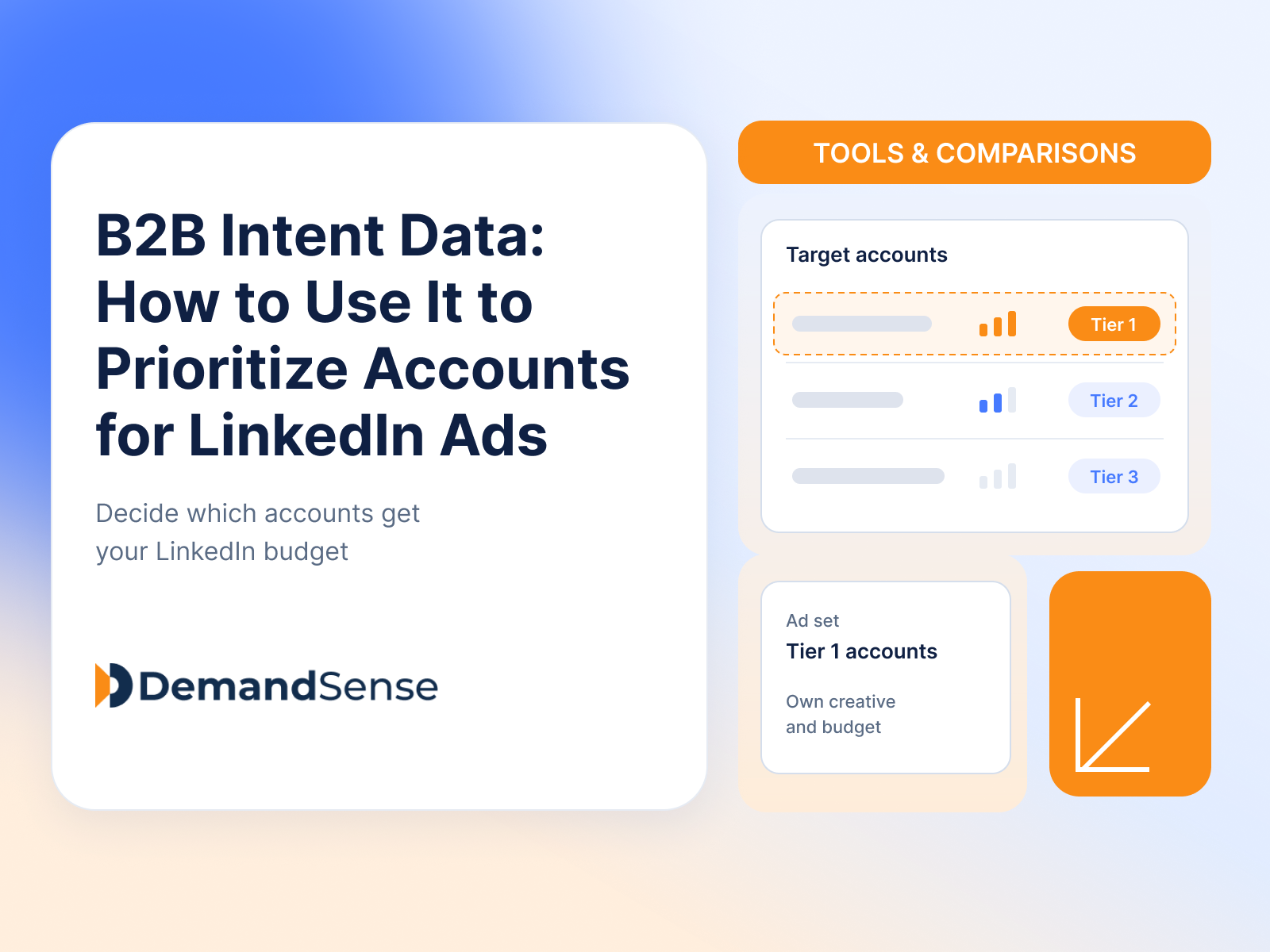
LinkedIn Ads
Tools & Comparisons
What B2B intent data is, how the main providers differ, and how to use intent signals to decide which accounts get your LinkedIn Ads budget.
LinkedIn Ads
Tools & Comparisons
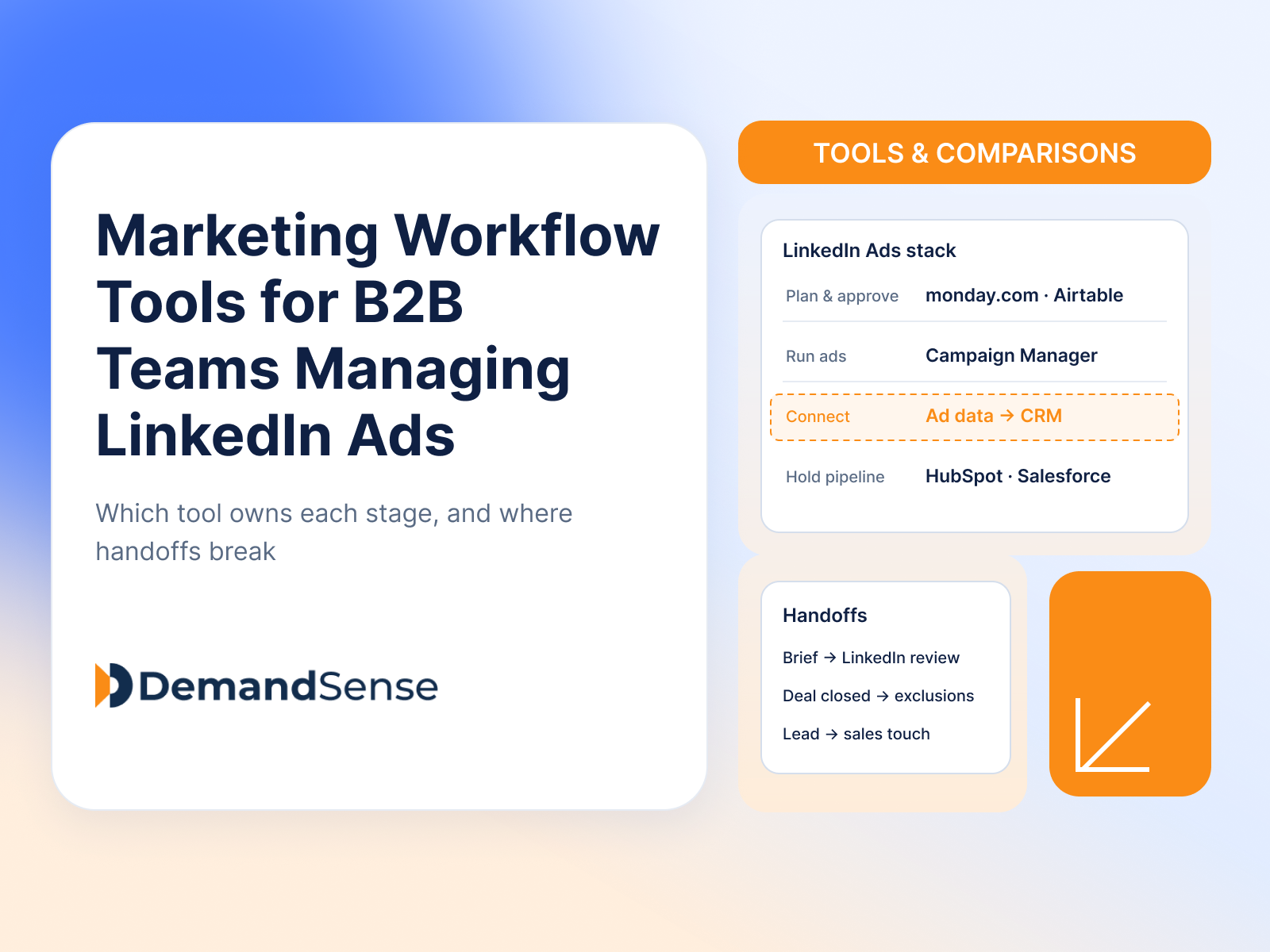
The marketing workflow tools B2B teams use to plan, launch, monitor and measure LinkedIn Ads, which stage each one owns, and where the handoffs break.
LinkedIn Ads
MCP & AI Hub
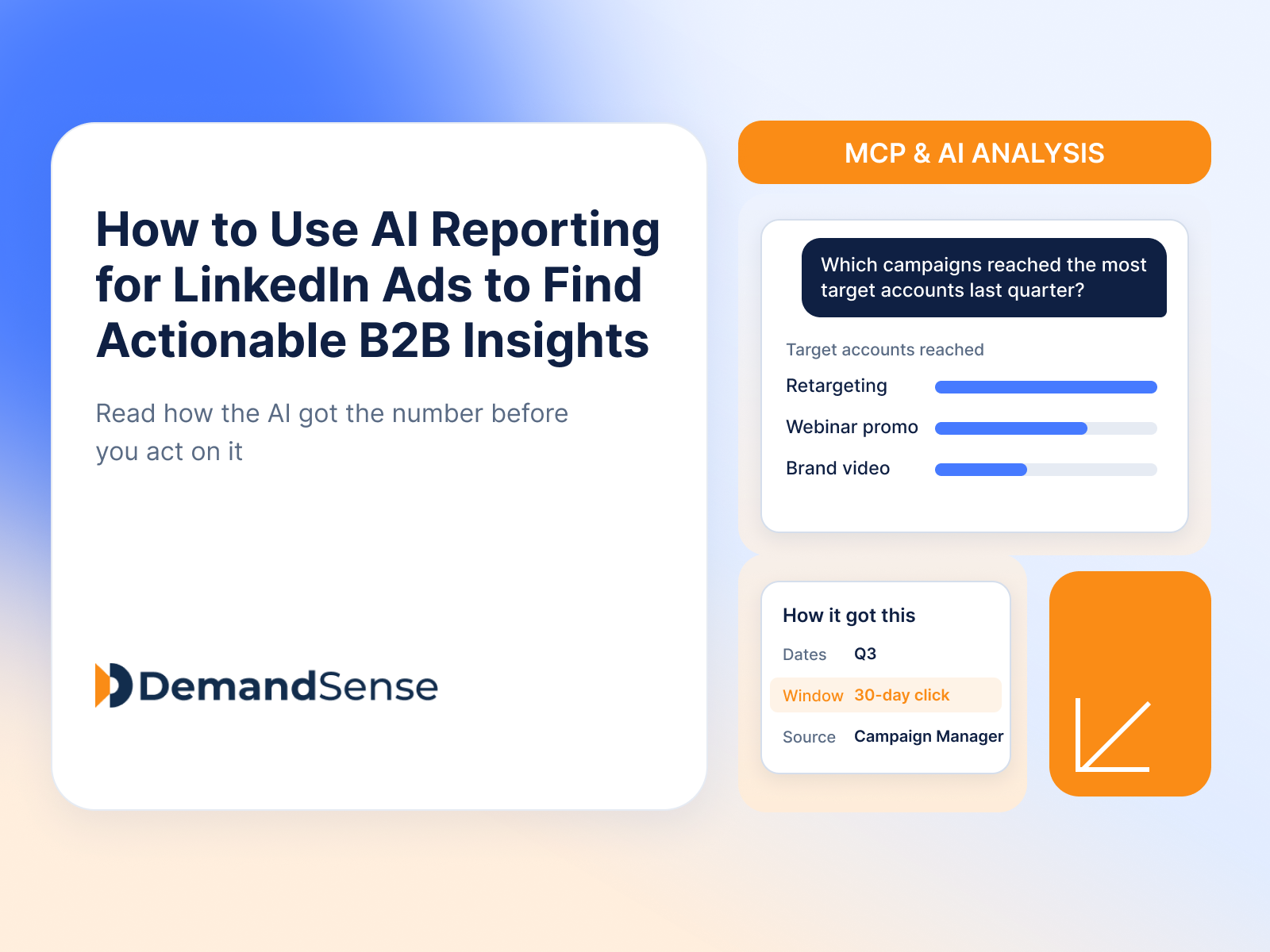
Learn how to use AI reporting for LinkedIn Ads: which data to connect, what to ask, how to validate the answer, and where generic AI tools fall short.
