LinkedIn Ads
Best Alternatives to Native LinkedIn Targeting
The best alternatives to native LinkedIn targeting: Microsoft Advertising, Google Search, ABM platforms and more, and which one fits your goal.
What an MQL and an SQL are, how to qualify leads from LinkedIn Ads, and why lead quality, not lead volume, decides whether campaigns build pipeline.
A LinkedIn Lead Gen Form takes a couple of taps to submit, so a campaign can report a few hundred leads in a month while sales books a handful of calls from them. Marketing counts the first number and sales counts the second, and both are right about what they see.
MQL and SQL are the labels for those two counts. This article covers what each one means, where the SAL fits between them, how to qualify leads that come from LinkedIn Ads, and how to tell which campaigns produce SQLs.
A marketing qualified lead (MQL) is a lead that marketing has judged a good fit for your ideal customer profile (ICP) and that has shown interest through its behavior. It has not spoken to sales yet, so its readiness to buy is still unconfirmed.
Signs that a lead qualifies as an MQL:
An MQL is a marketing judgement against criteria you wrote down, and it is still a guess about readiness.
A sales qualified lead (SQL) is a lead that sales has reviewed and confirmed has a real need, a role in the buying decision and a timeline worth pursuing. SQL status rests on a sales conversation as well as on marketing’s criteria.
Many teams check this with a framework such as BANT, which looks at budget, authority, need and timeline.
Typical SQL signals:
An SQL usually becomes an opportunity in the CRM, which is the point where the deal enters the sales pipeline.
The difference between an MQL and an SQL comes down to who decides and on what evidence. On LinkedIn, where LinkedIn Ads for B2B lead generation can bring in many forms quickly, that gap is easy to miss.
| Criteria | MQL | SQL |
|---|---|---|
| Buying Intent | Interest shown through engagement | Need and timing confirmed by sales |
| Qualification Owner | Marketing team | Sales team |
| Typical Signals | Lead Gen Form submission, repeat ad engagement, ICP fit | Demo or pricing request, confirmed need and role, validated timing |
| Funnel Stage | Top to middle of the funnel | Bottom of the funnel |
| Next Action | Lead nurturing or handoff to sales | Sales works it toward an opportunity in the CRM |
The usual path in the B2B funnel moves a lead through five stages, in this order:
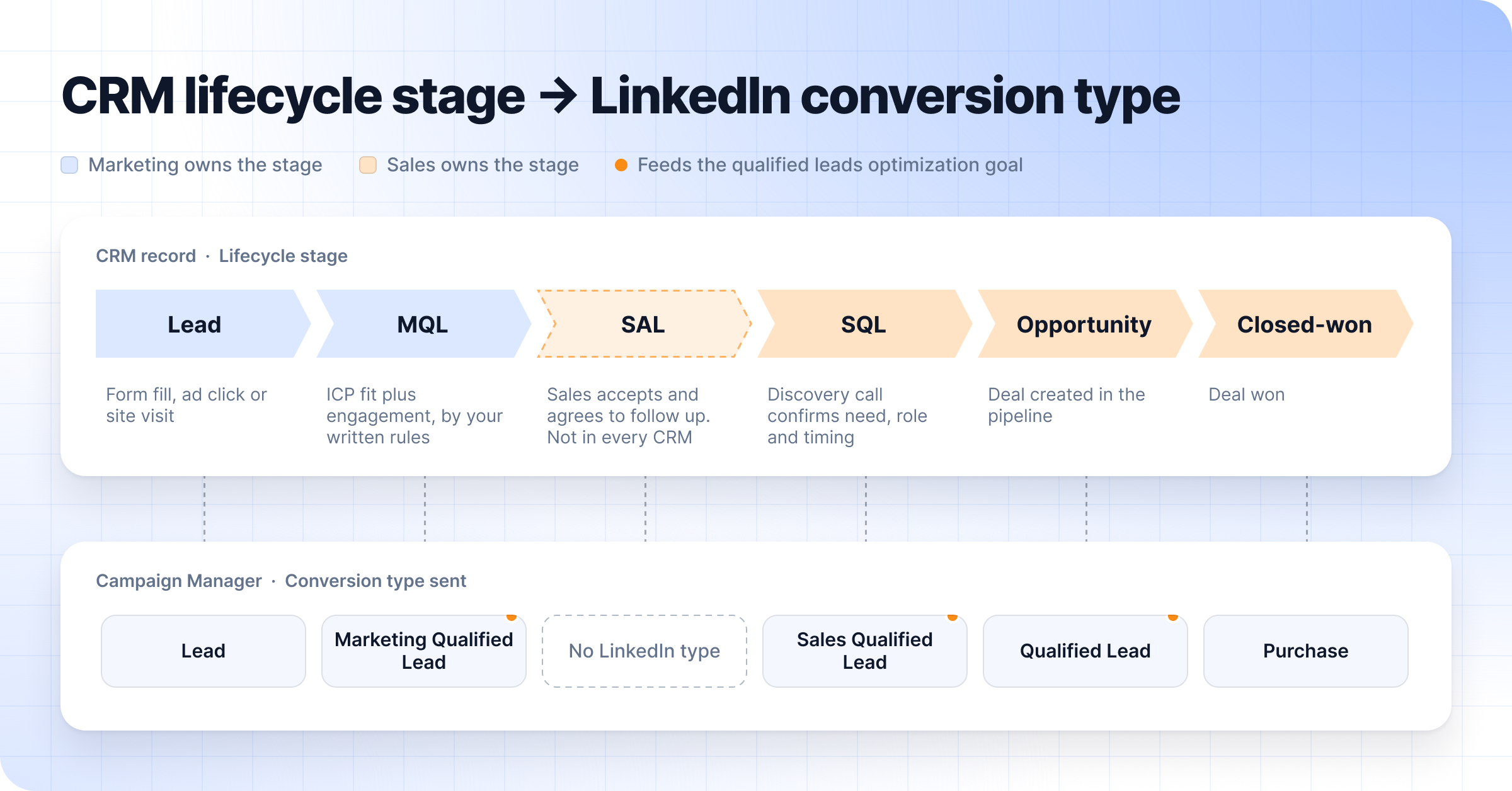
The SAL is the stage people ask about most. It sits between MQL and SQL. Sales has looked at the MQL and agreed to follow up, but nobody has qualified it yet. That gives sales a way to push back on leads that do not fit before they count toward pipeline, and it gives marketing a clear signal of which handoffs were accepted.
Definitions vary by company, and not every CRM has an SAL stage. HubSpot’s default lifecycle stages, for example, go from Lead to Marketing Qualified Lead to Sales Qualified Lead to Opportunity with no SAL in between. What matters is that marketing and sales write the same definitions down. Signals such as buyer intent tracking can inform when a lead is ready to move, but the stage rules still need to be agreed in advance.
LinkedIn gives you more fit data up front than most channels, because every lead arrives with a profile attached. Qualification works in three layers, in this order: fit, engagement, then sales validation.
Fit comes first, and you can judge it without any engagement. Check three things:
Lead Gen Forms pre-fill most of this profile data, so fit can be checked the moment a lead arrives. If your targeting is bringing in the wrong people, start with how to find your target audience on LinkedIn.
A fit lead becomes an MQL when it shows interest. Some signals say more than others. From strongest to weakest:
Lead scores put numbers on this: points for fit and for behavior, and a threshold for MQL. Example only: 20 points for a fit title, 20 for a fit company, 15 for a pricing page visit and 30 for a demo request, with 60 as the MQL threshold. Scores should decay when activity stops, or last quarter’s interest keeps a lead at MQL. For a view of engagement across a whole account, read about account-based intelligence.
The SQL decision is made in the CRM and in a conversation:
Those recorded reasons are the best feedback marketing gets on its targeting. If half the rejections say “too small” or “wrong role”, that goes straight back into the audience settings.
The case for lead quality starts with how easy a Lead Gen Form is to complete. Forms pre-fill profile data and keep the lead inside LinkedIn, which is why they tend to convert at a much higher rate than landing pages. Low friction raises the conversion rate, and it also lowers the bar for who fills the form in.
Three things go wrong when volume is the goal:
Volume is easy to report, but lead quality decides whether a LinkedIn campaign produces pipeline.
Who you reach, what you offer and what you teach LinkedIn to look for are the three levers on MQL-to-SQL conversion.
Start with accounts, then add attributes. Use company lists built from your ICP, add job function and seniority on top, and exclude customers, competitors and open deals. Then retarget accounts that have already engaged; the LinkedIn retargeting guide shows how to set that up.
Guides and ebooks bring in MQLs that need nurturing. A demo, pricing or assessment offer brings in fewer leads, but they are closer to SQL. Run them as separate ad sets so you can compare SQL rates.
On bottom-of-funnel forms, add one or two custom questions, such as timeline and team size, so qualification begins in the form. Keep the rest of the leads in retargeting and nurture them there until they show a stronger signal.
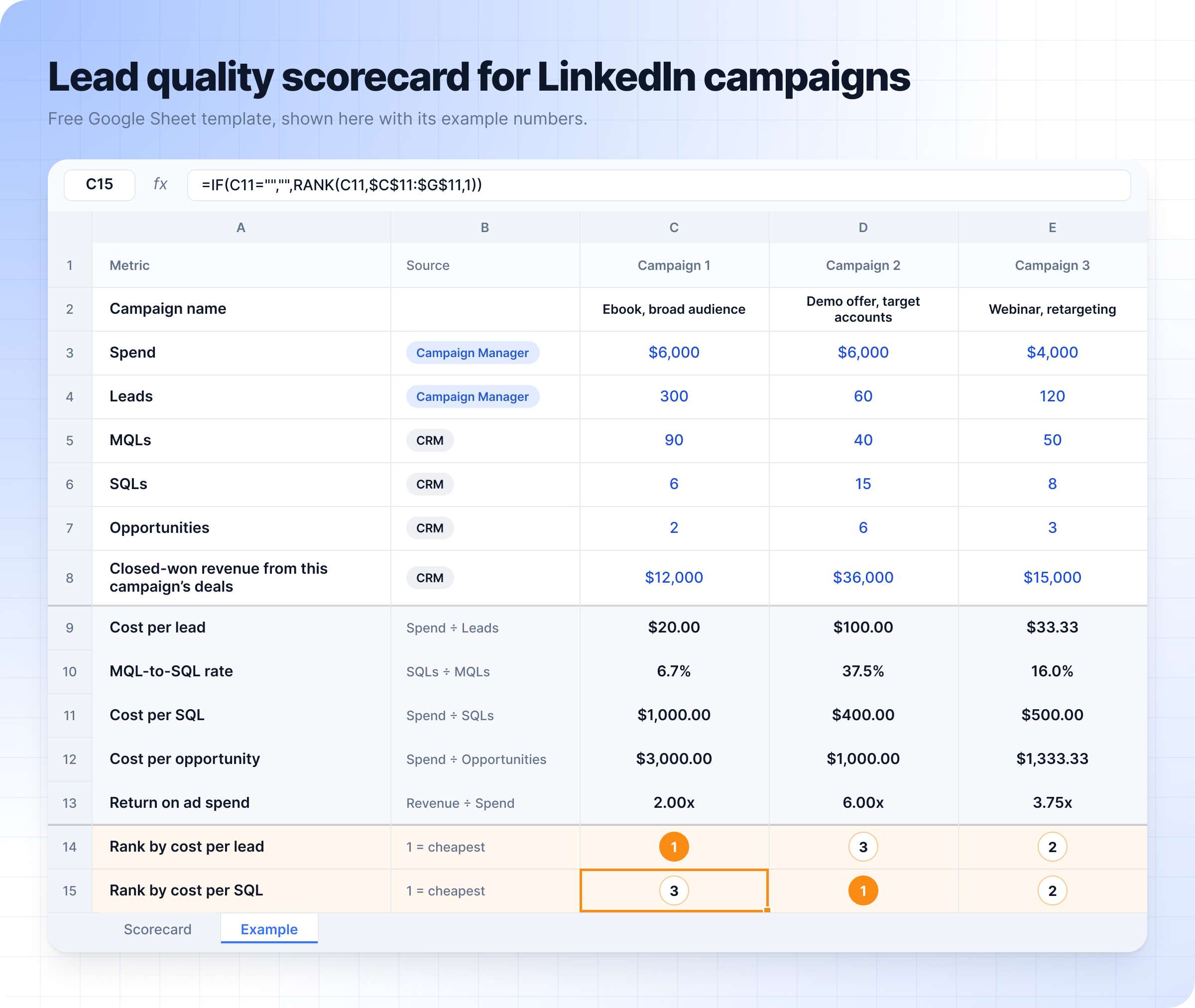
Lead quality scorecard template
A free Google Sheet. Add up to five campaigns and it ranks them by cost per lead and by cost per SQL, so you can see where the two disagree. It also works out MQL-to-SQL rate, cost per opportunity and return on ad spend.
DemandSense connects LinkedIn to HubSpot, Salesforce, Attio or Zoho and sends qualified opportunities and closed-won deals to LinkedIn through the Conversions API on a daily sync.
Marketing and sales can hand off leads cleanly if both teams agree on six things:
In practice that means the definitions live in a shared document, the rejection reasons live in the CRM, and both get reviewed in the same monthly meeting.
Campaign Manager tells you how many leads a campaign produced. Which of them became SQLs is recorded in the CRM, and the two numbers rarely end up in the same report.
DemandSense is a platform for the marketer who runs LinkedIn Ads in a small B2B team. It puts three things in one place that usually live in three separate tools: attribution, optimization, and website visitor profiling. On top of that sits an MCP server.
Who becomes an SQL is still decided by your CRM and your team. DemandSense shows which campaigns those SQLs came from.
Try DemandSense free for 30 days at demandsense.com, no card needed.
Yes, the order is MQL, then SAL, then SQL: sales accepts the lead first, then qualifies it. Many teams skip the SAL stage and move straight from MQL to SQL, so check how your own CRM defines the stages.
It can, if your MQL definition says so. It is safer to require ICP fit plus a second signal, or a form on a bottom-of-funnel offer. Lead Gen Forms pre-fill profile data, which makes submitting easy and makes a form fill a weaker signal than it looks.
Track cost per SQL, MQL-to-SQL rate, cost per opportunity, and pipeline and closed-won revenue by campaign. Average cost per lead on LinkedIn covers the cost side. DemandSense reads LinkedIn engagement next to CRM outcomes, so a team can judge campaigns by the pipeline they produced.
It depends on your sales cycle and the offer. A demo request will usually move faster than an ebook download. Measure your own median time from MQL to SQL by campaign in the CRM, and use that as your benchmark.
They go back to nurture: retargeting on LinkedIn, email, and content matched to what they engaged with. Keep them out of sales queues until they show new signals. See ways to nurture website visitors.
These labels vary between companies. An IQL (information qualified lead) shows early interest, often from a single content download. An AQL (account qualified lead) is qualified at the account level, which is common in ABM. An SAO (sales accepted opportunity) is a lead that sales has accepted as a pipeline opportunity.
Filed under
Written by
Kristina Haidai
LinkedIn Ads
The best alternatives to native LinkedIn targeting: Microsoft Advertising, Google Search, ABM platforms and more, and which one fits your goal.
LinkedIn Ads
Tools & Comparisons
Compare the best free LinkedIn tools for B2B marketing: competitor ad research, benchmarks, tracking and lead capture, and what each one gives you free.
LinkedIn Ads
Three free Claude marketing skills for LinkedIn Ads: find wasted spend, catch creative decay and list warm accounts for sales. Copy-paste prompts inside.
Get expert insights and strategies delivered to your inbox weekly.
