••
Insights & Resources
Expert strategies, case studies, and best practices for B2B marketing teams.
Expert strategies, case studies, and best practices for B2B marketing teams.
Ask Claude anything about your LinkedIn Ads, website visitors and CRM deals. DemandSense MCP
Private early access
LinkedIn Ads
Revenue Attribution & Measurement
Open your LinkedIn Campaign Manager dashboard, and you’ll see impressions, clicks, leads, and conversions climbing steadily. What you won’t see is whether any of that activity actually turned into pipeline, deals, or closed-won revenue. That gap is the core problem with a LinkedIn attribution model built only on native ad metrics: it tells you what happened on the platform, not what happened to your business.
For B2B teams, this is more than a reporting inconvenience. Ad spend decisions, budget optimization, and demand generation strategy all depend on connecting LinkedIn Ads activity to what the CRM shows: opportunities created, deals advanced, and revenue closed. Without that connection, you are left defending campaigns with click-through rates while sales and finance ask about ROAS and ROI.
This is where revenue attribution comes in: it links ad-level performance to CRM data, so marketing can show its real contribution to the buyer journey, not just activity on the platform.
Comparing LinkedIn attribution models side by side shows one thing clearly: no single model tells the whole story. Some differ in when they assign credit, others in whose activity they measure:
When B2B teams run these models side by side against the same CRM data, patterns emerge: campaigns that look weak on last-touch attribution often show strong influenced pipeline once impressions and account-level engagement are factored in. That comparison is what turns LinkedIn Ads reporting from a vanity-metric exercise into a real input for budget optimization.
A LinkedIn attribution model is the set of rules used to decide which LinkedIn Ads touchpoints get credit when a lead, deal, or piece of revenue shows up in the CRM. Instead of treating every impression, click, and engagement as equally important (or ignoring all but one), an attribution model assigns credit based on a defined logic: the first interaction, the last interaction, or something in between.
For B2B marketing, this matters because a single deal rarely comes from one touchpoint. A prospect might see a sponsored post, click a retargeting ad two weeks later, then convert after a direct visit to the website. The attribution model determines how much of that closed-won revenue gets credited to LinkedIn Ads, and to which specific campaign or ad.
Attribution models typically work at one of two levels:
Inside Campaign Manager, LinkedIn attribution runs on a fairly simple default: last-touch, click-and-view based. Here’s how it actually works:
This setup works reasonably well for short, single-touch conversions. It struggles with B2B, where a conversion window measured in days often closes long before a real buying decision does.
Instead of applying a fixed rule (like “credit the last click”), data-driven attribution uses machine learning to assign credit based on patterns in actual conversion data. LinkedIn’s own research team published LiDDA, a transformer-based attribution model that uses attention mechanisms to weigh each touchpoint’s contribution rather than crediting only the first or last interaction. LinkedIn has applied a version of it within its own ads measurement — a real shift away from last-touch, toward models that account for upper-funnel impact across the buyer journey.
First-touch attribution gives 100% of the credit to the very first tracked interaction — the ad impression or click that introduced the account to the brand. It’s useful for understanding which campaigns are driving initial awareness, but it ignores every touchpoint that came after, including the ones that ultimately moved the deal forward.
Last-touch attribution is LinkedIn’s default model in Campaign Manager, where full credit goes to the most recent ad interaction before a conversion. It’s simple and easy to report on, but for B2B specifically, it tends to reward bottom-of-funnel, high-intent campaigns while erasing the influence of the awareness and consideration-stage ads that built up to that final touch.
Rather than crediting one touchpoint, rule-based multi-touch models split credit across several using a fixed formula. Common variations include linear attribution (equal credit to every touchpoint), time-decay (more credit to touchpoints closer to conversion), and position-based or U-shaped models (heavier credit to the first and last touch, with the remainder split across the middle).
This is where attribution moves from ad platform to revenue outcome. LinkedIn’s Revenue Attribution Report (RAR) connects CRM data — HubSpot or Salesforce — to ad exposure, showing pipeline amount, revenue won, and ROAS for deals where a contact was exposed to LinkedIn Ads. LinkedIn expanded RAR’s lookback window to 365 days as part of its 2026 Conversions API and reporting updates, a meaningful shift for B2B teams whose sales cycles regularly run well past the platform’s original attribution windows.
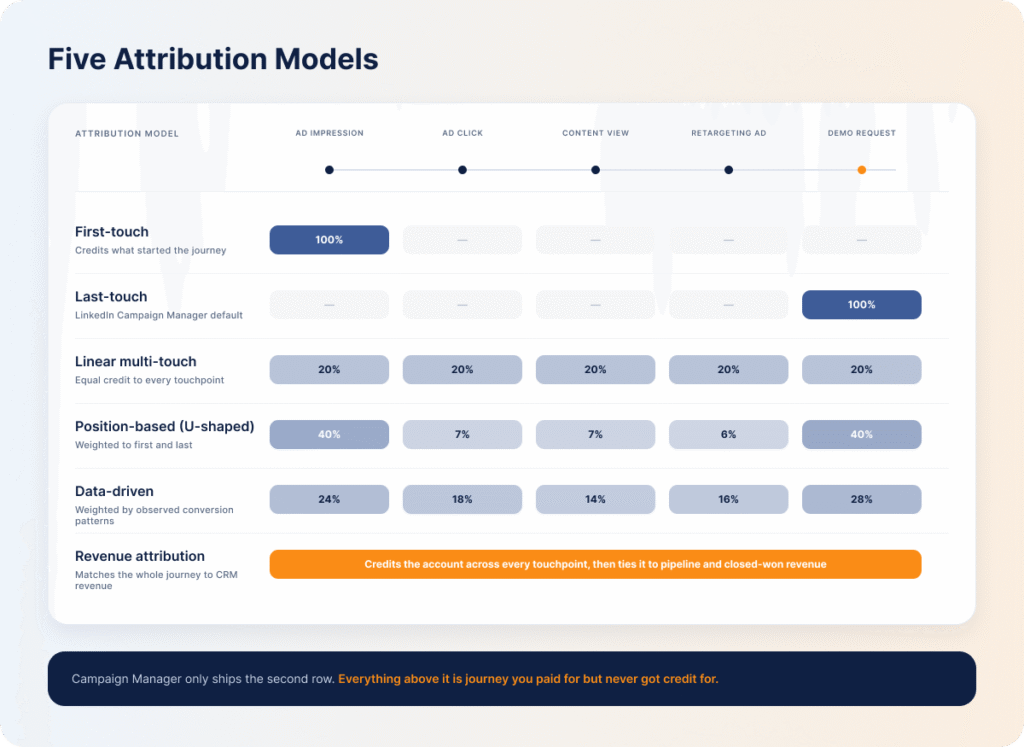
Campaign Manager and DemandSense measure attribution on fundamentally different timelines. Native LinkedIn reporting defaults to a 30-day click and 7-day view attribution window, with last-touch as the standard model — designed for shorter, more direct conversion paths. DemandSense takes the opposite approach: a configurable lookback window, six months by default, built specifically around how long B2B deals actually take to close.
The differences extend past the window itself:
| Attribution aspect | LinkedIn Campaign Manager (native) | DemandSense |
|---|---|---|
| Attribution window | 30-day click / 7-day view by default, extendable to 90 days | Configurable lookback, six months by default — built around real B2B sales cycles |
| Attribution model | Last-touch only, fixed unless manually adjusted | Awareness, Engagement, and Intent — DemandSense’s three-model framework, weighted by funnel stage |
| Attribution level | Individual click or view events only | Account-level AND contact-level, including company activity from people who never clicked |
| Revenue connection | Conversions shown inside Campaign Manager’s dashboard only | Syncs directly to HubSpot or Salesforce: active pipeline, closed-won, and closed-lost deals against actual ad exposure |
| Company identification | Not built in; relies on click/view events and form fills | WebID identifies companies globally, plus named contacts in the US |
None of this makes Campaign Manager reporting useless. It’s still the fastest way to check impressions, clicks, and ad-level performance in real time. It’s just not built to answer the revenue attribution question your team actually needs answered — for a closer look at how dedicated tools compare, see the best attribution software for B2B LinkedIn advertisers.
Native LinkedIn attribution was built around the assumptions of shorter, more direct conversion paths. B2B buying doesn’t work that way, and the gap shows up in a few specific ways:
One benchmark puts this in perspective: Dreamdata’s 2026 B2B benchmark study found an average buyer journey of 272 days involving 88 touchpoints before a deal closes. A 30-day attribution window, by definition, can only ever see a small fraction of that journey.
Building a LinkedIn attribution model that actually works for B2B reporting comes down to six steps:
Setting up a model is the easy part. Keeping it useful is where most teams drift:
Everything covered so far, including attribution windows, account-level engagement, mapping campaigns to revenue, is exactly what DemandSense is built to handle for LinkedIn Ads specifically.
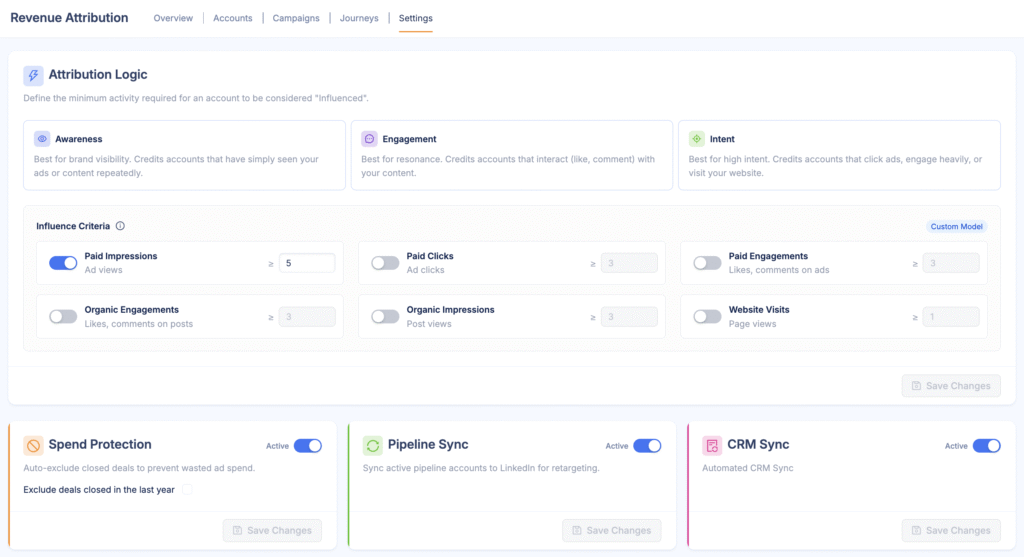
Instead of working around a 30-day click / 7-day view default, DemandSense runs on a configurable lookback window, six months by default, built around the actual length of a B2B sales cycle. Rather than defaulting to a single last-touch model, it offers three preset options — Awareness, Engagement, and Intent — so teams can weight credit differently depending on what they’re trying to measure. And instead of stopping at conversions inside a dashboard, DemandSense connects directly to HubSpot or Salesforce, so campaigns map to real opportunities, active pipeline, and closed-won revenue, not just leads.
That attribution data also feeds back into DemandSense’s own ad controls, so budget and audience decisions are driven by what’s actually influencing pipeline, rather than a best guess.
For B2B teams trying to build the kind of attribution model described above — define a goal, connect CRM data, track account-level engagement, map campaigns to revenue — DemandSense handles most of that setup natively rather than requiring it to be built manually across spreadsheets and exports.
LinkedIn Campaign Manager uses last-touch attribution by default: whichever ad interaction, click or view, happened most recently before a conversion gets full credit, within a conversion window of 30 days for clicks and 7 days for views.
The most effective LinkedIn ad format depends on the goal. For engagement and awareness, native, first-person content (including Thought Leader Ads) tends to perform strongly. For gated content and lead generation specifically, document ads are commonly cited as a strong performer because they let people preview content natively without leaving LinkedIn. There’s no single “best” format across every objective, so this is worth testing against your specific funnel stage.
Last-touch attribution is a common example of an attribution model: if a prospect clicks a LinkedIn ad, later downloads a whitepaper, then converts through a demo request three weeks later, last-touch attribution credits the demo request campaign alone, ignoring the earlier click and download.
The best attribution model for LinkedIn ads depends on your sales cycle length, deal complexity, and whether your goal is measuring leads, pipeline, or revenue. Multi-touch or data-driven attribution models generally give a more complete view of the buyer journey for B2B campaigns with longer sales cycles, while last-touch attribution can still be useful for short, high-intent conversion paths.
Campaign Manager reports on conversions, leads, and campaign performance inside the platform, but connecting that data to actual CRM revenue data, closed-won deals, or active pipeline requires either manual export and reconciliation or a third-party revenue attribution tool integrated with HubSpot or Salesforce.
LinkedIn attribution differs from CRM revenue data because they’re measuring different things on different timelines. LinkedIn attribution is based on click and view activity within a short conversion window. CRM revenue data reflects the full sales cycle — deals that may take months to close and involve touchpoints outside LinkedIn’s tracked window entirely.
To choose the right attribution model for LinkedIn campaigns, start by defining what you’re trying to measure (leads, pipeline, or revenue), then match the model to your sales cycle length. Shorter, simpler funnels can work with last-touch or first-touch attribution. Longer B2B sales cycles with multiple stakeholders are usually better served by multi-touch, account-level, or data-driven attribution — models built to reflect a real buying committee rather than a single click.
Get expert insights and strategies delivered to your inbox weekly.
Book a personalized demo and discover how we can transform your B2B marketing.
See a quick demo video
Revenue Attribution & Measurement
Tools & Comparisons
DemandSense vs Fibbler compared by the job you are hiring for: use cases, Conversions API, MCP, ad controls, pricing, and what reviewers of both tools say.

Revenue Attribution & Measurement
Tools & Comparisons
Discover the best marketing intelligence platforms for B2B. Empower marketing and revenue teams with competitive and market intelligence tools.

LinkedIn Ads
Revenue Attribution & Measurement
How predictive attribution works in B2B: which LinkedIn ad and account signals point to future pipeline, and how to act on them before deals appear.